


A Philosophical and Theological Critique of the Sikh Objection to the Incarnation of Christ.
Table Of Content
- INTRODUCTION
- I. PHILOSOPHICAL FLAWS IN THE CLAIM “GOD DOES NOT TAKE BIRTH”
- 1. Does This Limit God’s Power?
- 2. Does This Deny God’s Sovereignty?
- 3. Category Confusion: Birth vs. Origin
- II. INTERNAL SELF-CONTRADICTION IN SIKHISM
- 1. Pantheistic Monism and Divine Immanence
- 2. Guru Worship and Divine Attribution
- III. BIBLICAL TESTIMONY: GOD DID TAKE HUMAN FORM
- IV. WILLIAM LANE CRAIG’S PHILOSOPHICAL DEFENSE OF THE INCARNATION
- IV. FINAL REFLECTION: PHILOSOPHY, THEOLOGY, AND TRUTH
By Jasvir Singh Basi
Founder of TruthSikhers – www.truthsikhers.com
INTRODUCTION
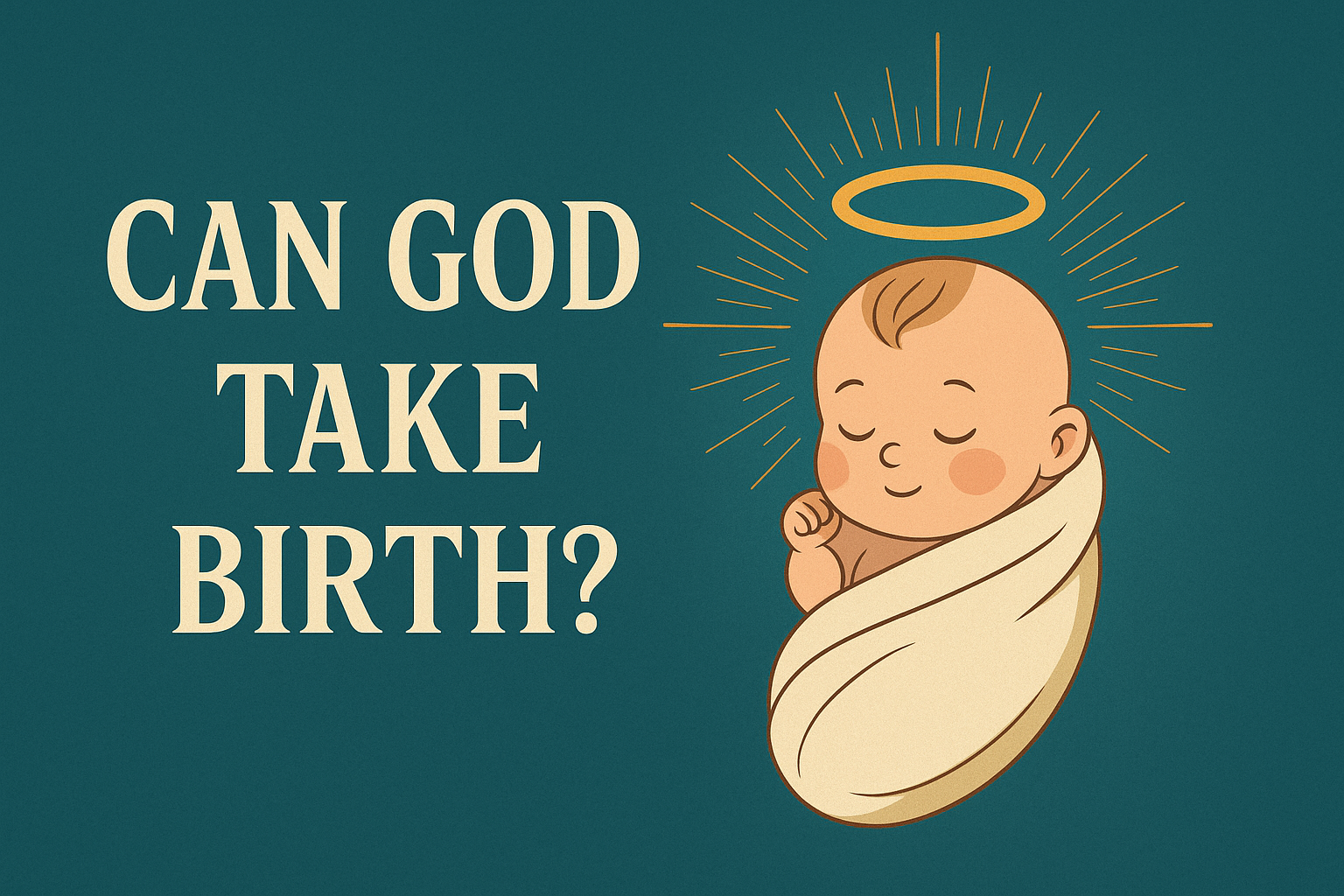
Many Sikhs and Muslims argue, “God does not take birth,” insisting that a formless, transcendent God cannot incarnate. This claim is frequently used to dismiss the central Christian doctrine of the Incarnation—that God became flesh in Jesus Christ (John 1:14). However, this objection is not only biblically unsubstantiated but also philosophically incoherent and theologically self-defeating, particularly within the Sikh worldview.
I. PHILOSOPHICAL FLAWS IN THE CLAIM “GOD DOES NOT TAKE BIRTH”
1. Does This Limit God’s Power?
If God is all-powerful (Sarbat Shaktimaan in Sikhism; Omnipotent in Christianity), then by definition He has the power to take on human form if He so wills. To say “God cannot” take birth is to impose a restriction on divine omnipotence—which is a contradiction.
– If God is truly limitless, then taking on flesh must fall within His capabilities.
– To assert otherwise is to reduce God to a prisoner of His own transcendence.
Yet Christian theology rightly maintains that God’s omnipotence is not arbitrary power. God can do all things consistent with His nature:
– God cannot lie because He is Truth (Titus 1:2).
– God cannot sin because He is Holy and morally perfect.
– God cannot cease to be God, for He is unchangeable in essence.
– God cannot do what is logically impossible, such as making a square circle or creating a married bachelor. These are not actual “things” to be done, but contradictions in terms—violations of logic, not expressions of power.
Thus, God’s inability to lie, sin, or perform logical contradictions is not a weakness but a reflection of His moral perfection and rational nature.
Philosophical Challenge:
If God is all-powerful, what logical or metaphysical barrier could prevent Him from entering His own creation in human form?
2. Does This Deny God’s Sovereignty?
A truly sovereign God is not limited by human assumptions or philosophical preferences. He acts in accord with His will and purpose, not ours. The Incarnation, according to the Bible, was a deliberate and sovereign act of God—not a necessity or compromise.
– John 1:14: “The Word became flesh and dwelt among us.”
– Philippians 2:6–8: God freely chose to humble Himself for our redemption.
Theological Implication:
If God is truly sovereign and chooses to take human form, who are we to say He cannot?
3. Category Confusion: Birth vs. Origin
When critics say “God cannot be born,” they conflate birth with origin. Jesus, the eternal Word (Logos), is not created—He is uncreated and pre-existent (John 1:1–3). His birth refers to His incarnation, not His origin.
– The eternal Word entered space-time, not because He came into existence, but because He came into our world.
Philosophical Clarification:
Incarnation does not mean God began to exist; it means He began to exist as man in addition to being fully God. He took on a human nature while fully God.
II. INTERNAL SELF-CONTRADICTION IN SIKHISM
1. Pantheistic Monism and Divine Immanence
Sikh metaphysics teaches a form of pantheistic monism, wherein God is believed to be in all things, and all things are in God—because God has become the creation itself. There is no real Creator–creation distinction, unlike in Christianity, where God remains wholly other and ontologically distinct from His creation.
Logical Tension:
– If God is already present in creation, what principled objection can there be to Him manifesting in human form?
– If He pervades rock, fire, water, and wind, why not a human body?
Challenge:
If God is immanent in the cosmos, then His assuming a human form is not a violation but a manifestation of His immanence.
2. Guru Worship and Divine Attribution
Guru Nanak and later Sikh gurus are often described in exalted, divine-like terms. Many Sikhs bow to the AG as the living “Guru.” This blurs the line between divine transcendence and manifest presence.
– If God cannot take birth, then why are gurus treated with divine reverence?
– If God’s presence can be mediated through a book as Sikhs assert for the Adi Granth, why not a body?
Self-Contradiction:
To affirm divine presence in a scripture but deny it in a human body is theologically arbitrary.
III. BIBLICAL TESTIMONY: GOD DID TAKE HUMAN FORM
The Bible does not merely speculate that God could become man—it boldly declares that He did:
– John 1:1, 14 – “In the beginning was the Word… and the Word was God… The Word became flesh.”
– Philippians 2:6–8 – “Being in very nature God… He humbled Himself… born as a human being.”
– Colossians 2:9 – “In Christ all the fullness of Deity lives in bodily form.”
This is not mythology; it is revelation rooted in real historical events.
Jesus Proved His Divinity:
– Miracles over nature, disease, and death (John 9:1–7; Mark 4:39; John 11:43–44)
– Power to forgive sins (Mark 2:5–7)
– Authority to rise from the dead (1 Corinthians 15:3–4)
Challenge to Critics:
If Jesus was not God, how do you explain the scope of His claims, His works, and His resurrection?
IV. WILLIAM LANE CRAIG’S PHILOSOPHICAL DEFENSE OF THE INCARNATION
Dr. William Lane Craig’s lecture “The Birth of God” offers powerful philosophical support for the Incarnation.
Key Quotes from Dr. Craig:
“In the Incarnation, God the Son takes on a human nature in addition to His divine nature. He doesn’t give up being divine—He adds humanity to Himself.”
“The doctrine of the Incarnation does not teach that a human being became God, but that God became man. The Second Person of the Triune Godhead, without ceasing to be God, took on a human nature.”
“The Incarnation is not illogical. It is a paradox—a mystery—but not a contradiction. God taking on a human nature is entirely within His power as a sovereign and omnipotent being.”
Citation:
William Lane Craig, “The Birth of God,” Reasonable Faith. Available at:
https://www.reasonablefaith.org/videos/lectures/the-birth-of-god
IV. FINAL REFLECTION: PHILOSOPHY, THEOLOGY, AND TRUTH
To say that God “cannot” take birth is not a defense of God’s greatness—it is an assault on His freedom.
– It substitutes human speculation for divine revelation.
– It elevates metaphysical preference above scriptural testimony.
– It confines God to an abstract category instead of recognizing His living self-disclosure.
Respectful Challenge to Sikh Thinkers:
If God is all-powerful, sovereign, and present in all things—what consistent reason can you offer to say He cannot enter His creation in human form?
Jesus Christ is not one more prophet or guru. He is God in flesh—unique, sinless, risen, and reigning.


No Comment! Be the first one.