



Refutation of the YouTube Short video: “Crusade ਦਾ ਕੀ ਅਰਥ ਹੈ ❓“
Video: https://www.youtube.com/shorts/n_8XLISu_Lw
The Sikh speaker says that the word crusade is not in the Bible and encourages the listeners to Google the word and see it’s negative connotations. He says that the word jihad does not occur in the Qur’an just as the word crusade does not occur in the Bible.
RESPONSE:
The speaker correctly states that the word “crusade” does not appear in the Bible. However, he is factually wrong when he claims that the word “jihad” does not appear in the Qur’an.
1. The Word “Jihad” Absolutely Appears in the Qur’an
Contrary to the speaker’s claim, the Arabic word “jihad” (جهاد) is present in the Qur’an multiple times. Examples include:
• Surah 29:69 – “As for those who strive (جَاهَدُوا) in Us, We will surely guide them to Our paths.”
• Surah 9:73 – “O Prophet, strive (جاهِدْ) against the disbelievers and the hypocrites and be harsh with them…”
• Surah 8:72 – “Indeed, those who have believed and emigrated and striven (جَاهَدُوا) with their wealth and lives in the cause of Allah…”
Even verses that don’t use the word explicitly (like Qur’an 2:190) speak about fighting in Allah’s cause and are interpreted by classical scholars as referring to armed jihad.
“Fight in the cause of Allah those who fight you, but do not transgress limits; for Allah does not love transgressors.” (Qur’an 2:190)
2. Hadith Literature Reinforces Military Jihad
The Hadiths—recorded sayings and deeds of Muhammad—abundantly use the term jihad, often in a military sense:
• “I have been commanded to fight the people until they testify that there is no god but Allah…” — Sahih Muslim 1:33; Bukhari 1:2:24
• “He who dies without having fought or thought of fighting has died upon a branch of hypocrisy.” — Sahih Muslim 6:4696
Muhammad personally led or commanded dozens of military jihads. This is not spiritual metaphor—it was violent armed conflict.
3. Jesus vs. Muhammad: A Stark Contrast
The speaker falsely equates Christian and Islamic approaches to warfare.
• Jesus Christ never raised a sword, never led an army, and explicitly rejected violence. When Peter used his sword to defend Jesus during His arrest, Jesus commanded, “Put your sword back in its place… for all who take up the sword will perish by the sword” (Matthew 26:52).
• By contrast, Muhammad participated in and sanctioned multiple battles, including Badr, Uhud, and the Battle of the Trench.
Thus, Christians did not learn warfare from Christ—but Muslims learned it directly from their prophet.
4. The Historical Context of the Crusades
Let’s be clear: the Christian Crusades came 4 centuries, yes 400 years after Islam’s spread by the sword across the Middle East, North Africa, and into Europe. The Crusades were a defensive response to:
• Centuries of Islamic aggression, tyranny and expansion
• Destruction of churches and Christian communities
• The killing and persecution of Christian pilgrims in Jerusalem and the Holy Land
The First Crusade (1095) was not an act of colonial aggression—it was a reaction to centuries of unprovoked Islamic jihad.
The crusaders left their homes, wealth, and comfort, enduring great hardship for what they saw as a just cause. When funding and manpower ran out, the campaigns ended.
5. Fallacy Alert: The Strawman Argument
The speaker commits a strawman fallacy by misrepresenting what Ankur Narula’s “crusades” actually are. These are not military campaigns. They are spiritual evangelistic rallies.
To equate a Christian prayer meeting or Gospel campaign with Islamic conquests and beheadings is intellectually dishonest and morally absurd.
Conclusion: Truth Matters
• Yes, the word “crusade” is not in the Bible.
• But jihad is in the Qur’an—and it’s not just about inner struggle.
• Jesus never preached holy war—Muhammad did.
• The speaker’s comparison fails historically, theologically, and logically.
If you’re going to make bold comparisons, get your facts straight. Don’t confuse spiritual outreach with centuries of conquest.
For more information read
The New Concise History of the Crusades by Thomas F. Madden
The Crusades: The Authoritative History of the War for the Holy Land
by Thomas Asbridge
God’s Battalions: The Case for the Crusades by Rodney Stark


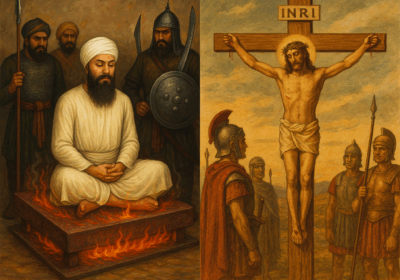


During the late 17th century, under Mughal rule in India, particularly from Emperor Aurangzeb, it is believed that forced conversions were happening, and Guru Gobind Singh sought to protect the Sikh religion by giving swords and weapons to sikhs to kill anyone who converted sikhs.
Even today, they carry weapons with the same intention under the pretext of religious practice.
Sikh militarization under Guru Gobind Singh arose in response to persecution and forced conversions under Aurangzeb, affecting both Sikhs and Hindus. It was resistance against agents of state-backed coercion, not a standing mandate to kill on religious grounds. The modern kirpan is a symbolic article of faith and has no sanctioned intent to harm or punish others, nor is there evidence of an ongoing religious purpose tied to violence. Assertions that contemporary Sikhs carry weapons today with the same intention are historically false and unjustified.