

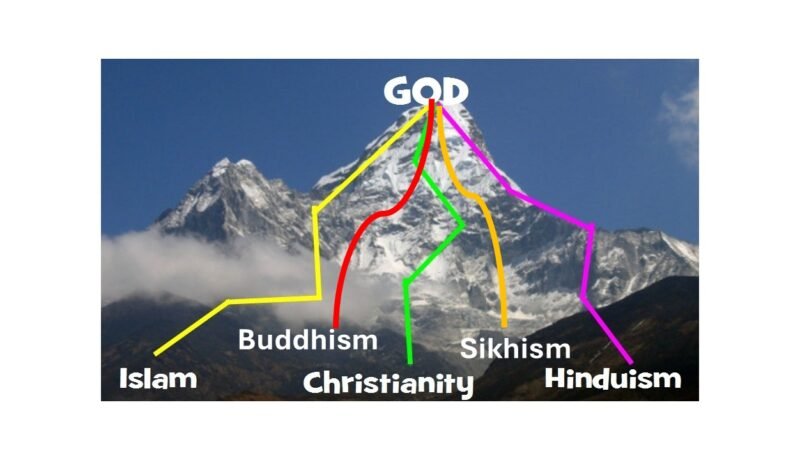
The Mountain-Top Illusion
By Jasvir Singh Basi
October 5, 2025
It is quite common to hear Hindu and Sikh friends say, “All religions lead to the same destination.” They often use the mountain-top illustration: “There are many paths to the top of a mountain, but they all reach the same peak.” Or they repeat the old adage, “All roads lead to Rome.”
At first glance, such analogies sound appealing, even humble and inclusive. But upon closer examination, they are philosophically indefensible and logically incoherent. They commit a classic category mistake—confusing physical paths with non-physical realities.
God is not a mountain, nor a geographical location one can reach by walking a different trail. God is non-spatial, non-physical, and non-temporal. To speak of “paths” to God in the same way one speaks of paths up a mountain is to confuse the physical with the metaphysical—comparing apples with oranges.
Truth Is Not a Mountain
Similarly, “Truth” is not a destination you can locate on a map or GPS. It does not occupy space-time coordinates. Truth consists of propositions—claims about reality that are either true or false. Every religion presents a set of propositional truth-claims that form its worldview: Who is God? What is man? What is salvation? What is ultimate reality?
These truth-claims are not paths in a physical sense. They are statements of belief that describe reality. Therefore, to equate “different paths” with “different truths” is to confuse ontology (what is) with geography (where it is). The path to your house or the summit of Mount Everest is physical; belief systems are conceptual and propositional. The two belong to entirely different categories of reality.
The Logical Collapse of the Mountain Analogy
When someone claims, “There are many paths to the top of a mountain; therefore, there are many paths to God,” the conclusion simply does not follow. This is a textbook example of the logical fallacy known as a non sequitur—a conclusion that fails to logically arise from its premise.
Yes, there may be multiple routes to reach your house or a mountain summit—but that is an observation about physical space. To then infer that all religions therefore reach the same God is an invalid leap in logic. The analogy collapses because it draws a metaphysical conclusion from a spatial example.
This is what philosophers call a category error—a fallacy that arises when concepts from one domain (like geography) are misapplied to another domain (like theology). The result is confusion masquerading as inclusivity.
Contradictory Truth-Claims Cannot All Be True
If all religions lead to the same God, then their truth-claims must be mutually consistent. But they are not.
- Christianity proclaims one eternal, suprapersonal Triune God who entered history through the incarnation of Jesus Christ.
- Hinduism teaches an impersonal ultimate reality (Brahman) where individuality dissolves in absorption.
- Sikhism affirms a pantheistic-monistic view where creation and Creator are essentially one continuum.
- Islam denies the deity of Christ altogether.
These are not different “paths” to the same summit; they are different summits altogether—each describing a fundamentally distinct God and a mutually exclusive view of salvation.
Contradictory propositions cannot all be true at the same time and in the same sense. Either all are false, or one alone corresponds to reality. As Aristotle’s Law of Non-Contradiction reminds us: A cannot be both A and not-A at the same time and in the same respect.
False Analogy, False Security
The “many paths to God” slogan is attractive because it sounds tolerant. But truth is not determined by emotional comfort. A false analogy may offer a temporary sense of unity, yet it conceals a dangerous relativism. If truth is relative, then nothing is absolutely true—including the statement that “all paths lead to God.”
Thus, the mountain-top illustration is not an argument but an opinion disguised as metaphor. It assumes—without evidence—that all religions are equally valid and salvific. But this assumption itself demands justification: On what rational basis can mutually exclusive truth-claims all be true?
A Better Analogy: Many Roads, Different Cities
A more accurate picture would be this: yes, there are many roads—but they lead to different destinations. You cannot drive north and south at the same time and expect to arrive at the same city. Direction matters. Destination matters. And truth matters.
Conclusion: Seek Truth, Not Comfort
The claim that “all paths lead to God” may sound humble, but it actually trivializes God and truth itself. It reduces the profound question of salvation to sentimental pluralism.
Before you accept such an appealing illustration, ask:
“Illustrations are not arguments. Truth is not determined by analogy but by correspondence with reality.”
- What is the nature of God in each faith?
- What is the basis for forgiveness or liberation?
- Do the core doctrines align or contradict each other?
When examined rationally, the mountain-top analogy crumbles under the weight of its own incoherence.
There may be many paths up a mountain—but only one path leads to the living God, the One who revealed Himself in history, entered time and space, and offered redemption through Jesus Christ—the true and eternal Satguru.
Explore Further: Why Jesus Is the Only Way
The Trouble with the Elephant
Answering the Challenge of the Blind Men and the Elephant


Excellent
Thanks for this helpful article