

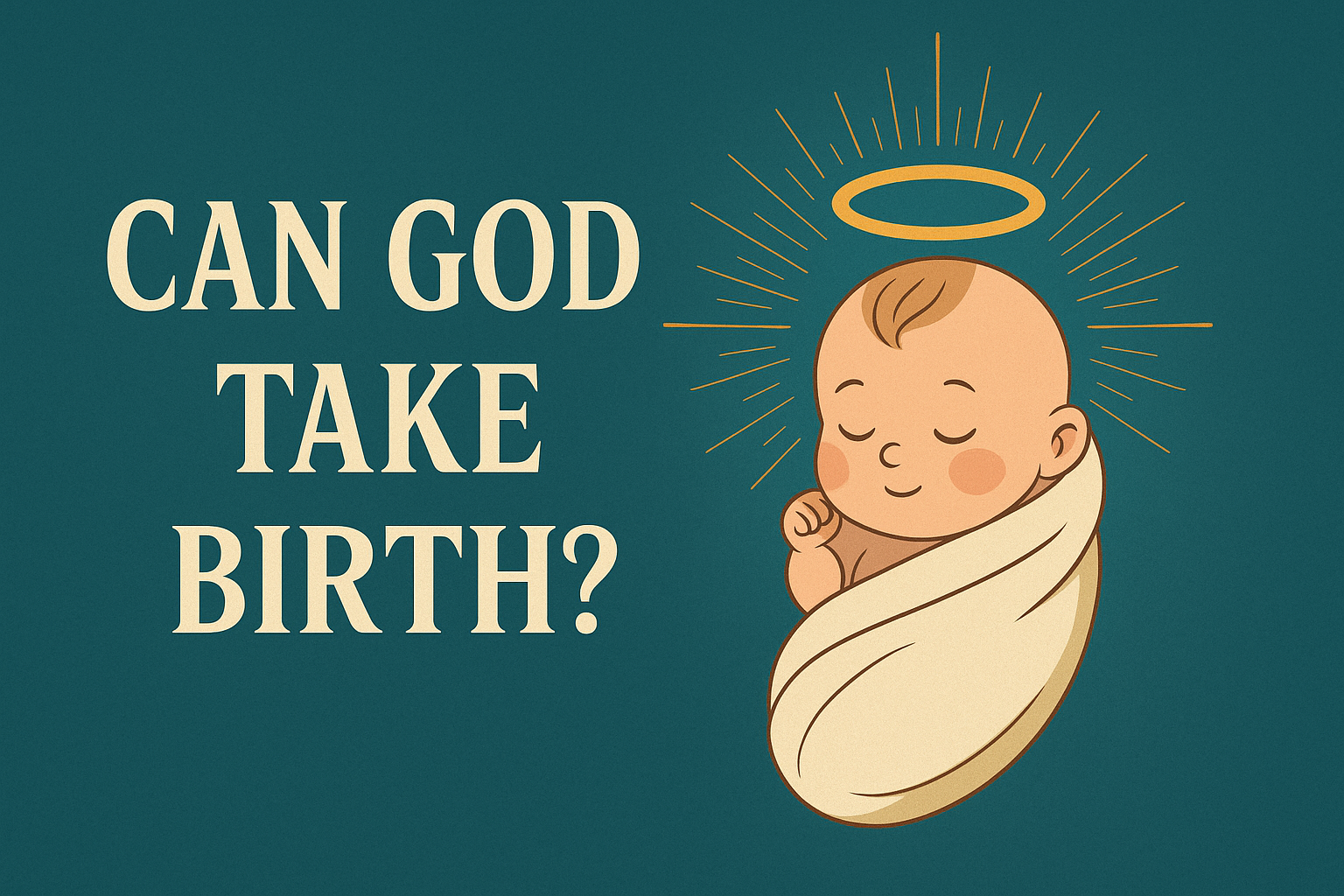
There are thirteen instances of phrases like “God created Himself” in the AG (Adi Granth). The clearest example is:
ਆਪੇ ਆਪੁ ਉਪਾਇ ਉਪੰਨਾ)
“He Himself created Himself and came into being.” (AG p1051 M3
This verse clearly defines the act of God creating Himself as coming into being from non-being, i.e., from non-existence to existence. Therefore, the term “created” refers to God’s coming into existence, not merely changing from one form to another. Guru Amardas affirms that the phrase “created Himself” refers to God’s emergence from non-being, not a shift in form, for example from nirgun to sargun as some Sikh apologists argue. The verse is a nonsensical contradiction, for God would have to exist before He existed.
1. The Core Text and the Claim
The Sikh apologist’s claim is that this does not imply creation from non-being, but rather a self-manifestation or internal transformation (e.g., nirgun → sargun) of form.
This move fails both linguistically and philosophically.
2. “ਉਪੰਨਾ” Explicitly Denotes Coming Into Being
The verb ਉਪੰਨਾ (uppannā) in classical Punjabi/Braja/Sant Bhāṣā carries the sense of:
- arising
- originating
- coming into existence
- being produced
It does not mean:
- revealing what already exists eternally
- manifesting a hidden form
- re-describing an eternal state
If the text intended mere manifestation, terms like ਪਰਗਟ, ਪ੍ਰਕਾਸ਼, or ਪਸਾਰਾ would have sufficed. Instead, the language chosen is ontological, not descriptive.
Therefore, the verse explicitly teaches ontogenesis, not self-disclosure.
3. “Created Himself” Necessarily Implies Non-Being → Being
Creation, by definition, entails:
- a prior state where the created entity did not exist
- a transition into existence
To say “God created Himself” logically entails:
- God did not exist.
- God acted.
- God came into existence.
This produces an unavoidable contradiction:
- A non-existent being cannot perform an act.
- An agent must exist prior to agency.
Thus, the statement collapses into incoherence.
4. The Temporal Paradox Is Inescapable
For God to create Himself, God must:
- exist before He exists
- cause Himself before He is
This is not a mystery; it is a formal contradiction.
No appeal to “divine paradox” rescues this claim, because paradoxes may transcend comprehension, but contradictions destroy meaning.
A triangle with four sides is not “mysterious”; it is nonsense.
5. The Nirgun → Sargun Escape Route Fails
Some Sikh interpreters attempt to reinterpret the verse as:
“God did not come into existence; He merely transitioned from nirgun to sargun.”
This fails for three reasons:
(a) The Text Does Not Say This
The verse does not say:
- “He manifested Himself”
- “He appeared as creation”
- “He assumed form”
It says ਉਪੰਨਾ — came into being.
Eisegesis cannot rescue defective metaphysics. Eisegesis is reading into the text what is not there.
(b) Nirgun Cannot Become Sargun Without Change
If God truly transitions from nirgun to sargun, then God:
- acquires attributes He previously lacked
- undergoes change
This violates divine immutability and perfection. A perfect being cannot become “more expressed” without implying prior deficiency.
(c) If Nirgun Is Indistinguishable From Non-Being, the Problem Returns
In many AG contexts, nirgun is described as:
- beyond attributes
- beyond distinction
- beyond form
- beyond relation
At this point, nirgun collapses functionally into non-being.
If God “emerges” from nirgun into sargun, this is existence arising from non-existence—exactly the problem Sikh interpreters are trying to avoid.
6. Self-Causation Is Metaphysically Impossible
Nothing can be the cause of itself, because causation presupposes:
- ontological priority
- explanatory asymmetry
A cause must be logically and ontologically prior to its effect.
To say “God caused Himself” is equivalent to saying:
- “X exists because X exists.”
This explains nothing and violates the Principle of Sufficient Reason.
7. The Repetition of This Language Makes the Problem Worse, Not Better
This phrase occurs multiple times (≈13 instances).
Repetition does not normalize contradiction.
Instead, it demonstrates that AG repeatedly affirms a self-negating ontology, oscillating between:
- God as eternal and unborn
- God as arising, emerging, and being produced
This is not poetic tension; it is metaphysical inconsistency.
8. Contrast With Coherent Theism
Classical theism (Biblical, Jewish, Christian) avoids this incoherence by affirming:
- God is uncaused
- God is eternally existent
- God does not come into being
- Creation is a free act, not a self-generation
God does not explain Himself by reference to Himself as an effect.
9. Final Assessment
The claim that “God created Himself” entails one of the following, all fatal:
- God came into existence from non-existence (not God).
- God existed before He existed (logical contradiction).
- God changed from imperfection to perfection (not God).
- Language in AG is metaphorical to the point of meaninglessness (theological collapse).
None of these options preserves a coherent doctrine of God.
Conclusion
The assertion that “God created Himself” is not a deep mystery, nor a profound insight.
It is a category error, a logical contradiction, and a metaphysical impossibility.
A God who must bring Himself into being is not the ultimate reality; He is a dependent effect masquerading as a cause. This verse does not exalt God—it undoes Him.
QUESTION
The decisive question, therefore, is unavoidable: Is the AG, the Guru of the Sikhs, truly the Word of the Living God? True divine revelation does not generate logical contradictions about God’s existence, nor does it require continual reinterpretation to escape incoherence.


Thank you, Truth Sikhers, for explaining the difficulty in this text so clearly.
Its really a mess, clearly nanak and other so called gurus didn’t even know simple logic.