
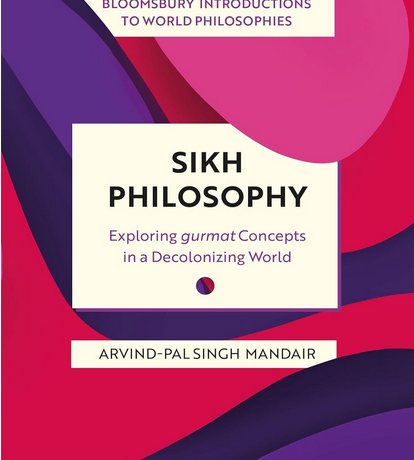
A Comprehensive Review of Arvind Mandair’s Sikh Philosophy
By Jasvir Singh Basi
Introduction: Scope and Purpose of This Critique
This article presents a comprehensive critique of Arvind Mandair’s Sikh Philosophy. The purpose is not to question motives or academic credentials, but to evaluate the work as philosophy and theology: its method, coherence, use of logic, handling of key Sikh concepts, and fidelity to the Adi Granth (AG). The analysis proceeds cumulatively, showing how methodological assumptions generate theological and ontological conclusions.
Chapter-by-Chapter Overview of Sikh Philosophy
Here is a brief summary of each chapter based on Arvind’s own summary in the Introduction of his book (pages 16 to 20).
Chapter 1: Arvind covers the major interpretive traditions (prnalian) of Sikh thought and encounter of Sikhism with modernity in the 19th century.
Chapter 2: Arvind addresses the question of authority of Sikh philosophy, is grounded in the spiritual experience of guru Nanak. He says that the nature of this experience has been variously interpreted, ranging from politico-ethical monotheism to a discourse of consciousness and spirituality often wrongly characterized as monism. He says that the choice between the two options is a misleading one, resulting in an either/or oppositional thinking. He says that the logic that underpins the categories of monotheism, monism and pantheism is derived from a Christian worldview and inherited from the Euro-Christian colonial knowledge system.
He also touches on the subject of revelation as transcendental experience and asks whether it can be applied to gurbani. If so, does this mean that gurmat is essentially theological (monotheistic) in its impulse. He says that guru Nanak’s own testimony moves the discussion of experience and authority towards ego-death.
Chapter 3: Arvind answers several questions, such as how can mere words or language be regarded as the ultimate authority in Sikhism? What is the relationship between the principle of sabda-guru and the nature of thought? What implication does sabda-guru have for the idea of a personal God?
Chapter 4 covers the ontology of Sikhism by looking at the creation cosmology of guru Nanak’s hymn, Raga Maru. He says that working through the cosmic and psychic dimensions, Nanak shifts the question of ontology into the language and realm of consciousness.
Chapter 5 explores the interlinked notions of death, life and rebirth. He answers various questions on the first two and then examines the Sikh theory of karma and whether it points to an inexorable law or elsewhere.
Chapter 6: The title is Self-Realization: Liberation and Health. Arvind focuses on mental and physical health by looking at kleshas – literally emotions. By this he is referring to the five thieves of Sikhism, kam (lust), krodh (anger), lobh (greed), moh (desire), ahankar (pride).
Chapter 7 is on the issue of bioethics, such as abortion and euthanasia. The book concludes with the sensitive topic of Hindutva ideology and political sovereignty and a homeland for Sikhs.
The key terms in the book are gurmat, self-realization, individuation, ego loss, and the One. He also equates dharam and gurmat with ontology and epistemology, respectively (page 1). He defines gurmat as the logic, instruction, knowledge or teaching of the guru. Endnote #12 for chapter 2 on page 226 illustrates Arvind’s anti-Western and anti-Christian bias, which drives much of the book. The endnote says, “Christianity was the premise for the European Enlightenment. The two cannot be separated as done in normative secular frameworks.” This false premise undergirds much of the book, but it is historically, philosophically, and religiously unjustified unless he can elucidate further. Unfortunately, he leaves many of his assertions open-ended without clarifying exactly what he means. His mischaracterization of Christianity is evident in what he says on pages 73-74:
The sources he cites in endnotes 1 to 4 of chapter 3 can hardly be described as “Christian” sources and is further evidence of his bias against Christianity. It is also hard to reconcile this with the universal and pluralistic nature of the Sikh faith.
As we have seen, Arvind condemns western concepts and methods of analytical philosophy as an importation by British colonialists, yet he adopts the western ideas of postmodern philosophers. Yet neither philosophical school is an indigenous Indian tradition through which he wants to interpret the “true” Sikhi. He does not realize that this goal contradicts his postmodern worldview in which there is no objective truth, only endless subjective interpretations. Arvind’s comments of “self-realization” is a rehash of New Age ideas cloaked in profound-sounding philosophical jargon to give it the appearance of credibility. Arvind has re-packaged Hindu New Age philosophy disguised under his systematic schema of postmodernism as Sikh philosophy, what he calls gurmat. He is trying to force-fit a square peg into a round hole. Again and again, Arvind talks of “Self-Realization,” e.g., on page 150ff, and has a whole chapter on it. On page 80, he asks, “how is it possible to actually experience the reality of oneness and, in so doing, become truly self-realized (kiv sachiara hoiae).” In effect, he defines a self-realized person from Guru Nanak’s Japji as a sachiara. On page 92, he speaks of a realized self as one who knows the truth of reality (sachiara).
He is basically pushing the same old idea of “self-realization” through altered states of consciousness. He is trying to fit the square peg of “western” postmodernism into the round hole of the teachings of the Guru Granth Sahib(gurmat). In his attempt to do this, he cannot avoid caricaturing the teachings of the Guru Granth Sahib by blatant eisegesis. But of course, being a postmodernist, he has no problem with this as he believes there is no objective meaning in any text — no meaning except his own meaning, which is another self-contradiction in his philosophy. In chapter 2 on Epistemology, his discourse on the symbol Ek Onkar and his interpretation of the mool mantra exemplifies his faulty hermeneutics and eisegesis.
He translates the mool mantra in a highly idiosyncratic way, which exemplifies his broader hermeneutical method: he repeatedly imports postmodern categories into the AG rather than deriving meaning from the text’s lexical and historical sense. This pattern continues in chapter 3, where he develops a “theory of gian as knowledge and consciousness” from Japji (p. 77). In doing so, he adds yet another speculative interpretation to the already crowded field of competing Japji readings. The consistent issue is eisegesis: Mandair reads his preferred philosophical conclusions into the text.
Postmodern Framework and Methodological Problems
A detailed analysis of every sentence in the book would require a whole book bigger than Arvind’s original text. I will therefore address the most important points and his overarching worldview. Nothing I write is in any way a personal attack on Arvind himself. Before embarking on this review, I contacted Arvind Mandair to ask him what his foundational a priori philosophical presuppositions and worldview are. He refused to give a direct answer and suggested that I read the book to discover the answer. After reading the book, it was evident that his book, Sikh Philosophy, was premised on the postmodern worldview, as were his previous books.
Arvind is customizing his interpretation of Sikhi/Sikhism to fit his foundational a priori preconceived philosophical beliefs, which are based on the leading continental philosophers of postmodernism. They are Jacques Derrida (1930-2004), Michael Foucault (1926-1984), Jean-Francois Lyotard (1924-1998), and American philosopher Richard Rorty (1931-2007). He blames the Sikh colonial elites for buying into modernism and its western modes of thought. By adopting the western mode of thought of postmodernism, he is doing the same thing himself. Unfortunately, Arvind is trying to force-fit a square peg into a round hole. Since his foundation consists of the shifting sands of relativism and subjectivism, the superstructure he builds on it ultimately collapses. In short, his worldview self-destructs; he cuts off the very branch on which he sits. I shall elaborate in this review.
Like his continental philosopher gurus, Arvind is quite obtuse in order to sound profound. Postmodernism’s lack of precise categories and definitions is irritating to analytical thinkers who value clarity and specificity. I think existential subjectivity would fit with what Mandair would want to describe about Nanak’s mystical experience of God. But his assertions are contradictory. Within a span of a few sentences, he says that it’s not appropriate to describe Nanak as having a “mystical experience” and then talks about Nanak’s “experiences.” on page 60, in a section entitled Manmukh, (who he defines as someone who has a “contracted consciousness”) he says that Guru Nanak favored the figure of the Beloved to express his mystical experience of oneness which was an experience of “absent-present, personal-impersonal, one-many, finite-infinite, at the same time. This is because the figure of the Beloved expresses a logic which gathers contradictions into a singular experience that is at work in every moment of our lives.” This is manifestly incoherent.
POSTMODERNISM
Postmodernism asserts relativism across the board and claims that truth is not objective but then claims to be the objective account of truth. Its self-referentiality makes it self-refuting. Since this inescapable self-referentiality is self-refuting, the entire edifice and superstructure Arvind builds on this foundation also crumbles. The postmodern movement began in France in the 1960s as a radical rejection of modernism. Postmodernism rejects several core modernist commitments, most notably the existence of objective and universal truth, the reliability of human reason to know reality, the stability of meaning in language, and the validity of universal logical principles. This rejection is often presented as a necessary corrective to the excesses and failures of modernism. However, it does not follow that modernism’s shortcomings justify postmodernism’s radical alternative.
Although I do not accept modernist beliefs without qualification, postmodernism’s wholesale denial of absolute and universal truth renders it philosophically and theologically untenable. This denial is itself contrary to the teachings of the Guru Granth Sahib regarding the nature of truth. As already indicated, postmodernism’s radical relativism is also self-defeating. In denying all absolute and universal truths, it implicitly affirms at least one absolute and universal truth—namely, that there are no absolute and universal truths. To affirm and deny the same proposition simultaneously is the very definition of a logical contradiction.
Postmodernists often attempt to evade this criticism by claiming that they do not acknowledge the objectivity, absoluteness, or universality of logical principles themselves. This move, however, only deepens the incoherence. One cannot reject the objectivity and universality of basic logical principles without presupposing them in the very act of formulating and asserting that rejection. Postmodernists have no alternative but to rely on the very principles they seek to deny. Otherwise, the sequence of words by which they attempt to reject logic would be meaningless gibberish rather than a rational assertion.
If the principle of non-contradiction is discarded, then words cannot retain fixed meanings, and sentences cannot convey determinate propositions. If a statement can mean anything, then it ultimately means nothing. The absoluteness of the law of non-contradiction is therefore a necessary condition for understanding, communication, and rational discourse. Without it, intelligible communication is impossible.
I will return to this issue in the following section. For now, it is sufficient to note that every theory of truth—including the coherence theory, the pragmatic theory, and the relativistic approaches favored by postmodernists—depends, in the final analysis, on the correspondence view of truth. Any theory that claims to offer a true account of truth implicitly assumes that its account corresponds to the way things actually are. In this sense, even theories that deny correspondence rely upon it in order to make their own claims intelligible.
Derrida claimed that everything is a text, by which he seemed to mean that everything is subject to an indefinite variety of interpretations. According to his claim, no sentences in any book have a fixed meaning, for meanings are as diverse as the individuals who read the sentences. This notion entails that there is no single author, for every reader becomes the author, and there is no way to determine whether any one of them is right. In fact, according to Derrida, there is no right interpretation. Derrida’s claim that everything is a text creates a dilemma, for to see everything as a text necessitates viewing his claim itself as a text that lacks any fixed meaning.
Furthermore, postmodernism itself is nothing more than a relative interpretation adopted by a social group, having no moral claim on reality or truth than any other social group’s perspective. As a text, postmodernism has as many interpretations as readers who hear or read the words of a spokesman. Consequently, postmodernism dies the death of endless interpretations that can mean anything and therefore means nothing. Thus, according to Arvind’s worldview, his book and his interpretation and exegesis of the Guru Granth Sahib is of no value whatsoever, for it lacks any fixed objective meaning.
According to postmodernism, there is no universal objective knowledge. Consequently, what is termed “knowledge” is primarily useful for a particular social group according to the group’s perceptions and needs. The American postmodernist philosopher Richard Rorty contended that none of our so-called knowledge “mirrors” reality as it is. Thus, neither scientists, philosophers, nor theologians can appeal to a mind-independent or language-independent reality to justify any of their claims. However, postmodernism’s claim that our knowledge can never be a correct representation of reality is incoherent, for one must know something about reality in order to know that our knowledge does not represent it. No one could possibly know this without being able to compare our mental representations with the way extra-mental things really are.
The main target of the postmodernist critique is metanarratives, which is another term for worldviews. In his book The Postmodern Condition: A Report on Knowledge, Lyotard asserted, “simplifying to the extreme, I define postmodernism as incredulity toward metanarratives.” For postmodernists, metanarratives include all religions (including Sikhism), philosophical systems, nationalism, and even science. However, given the sweeping, universal claims made by postmodernism about the way things really are, is itself also a metanarrative, one that falls under its own censure and collapses under its own incoherence. I believe that Arvind has uncritically jumped on the postmodern bandwagon, and positive reviews by peers appear to be by fellow postmodernists. Ironically, none of the leading postmodernist thinkers and shapers of Arvind’s worldview, whether Rorty, Derrida, Foucault, Lyotard, or Baudrillard, affirmed belief in a personal deity. They denied the objective existence of God and the supernatural and took the material universe to be all there is. This is ontological naturalism, also known as philosophical materialism. Like his postmodern heroes, Arvind disparages reason as a way to ascertain objective reality and truth. Yet Arvind writes as though there is objective reality and truth. He cannot have it both ways and make peace with logic. The notion that objective truth is unknowable entails the substitution of unviable relativistic views of truth.
As I have indicated, Arvind has been misled by postmodernist 20th-century French philosophers who derided reason and logic. It seems that Arvind could not see an alternative that would allow him to cling to the Guru Granth Sahib, which contains fundamental contradictions. Since these contradictions cannot be reconciled, he had to do away with the Guru Granth Sahib or the Law of Non-Contradiction. It seems that Arvind chose the latter because of his postmodern presuppositions. Arvind calls contradictions by the more palatable and innocuous term “opposites.” He knows that there are unresolvable plain and clear contradictions in the Guru Granth Sahib but his a priori presupposition that the Guru Granth Sahib is divinely inspired revelation leaves him no choice but to irrationally discard the Law of Non-Contradiction. Arvind is to be commended for recognizing that there are genuine contradictions in the Guru Granth Sahib, which Sikhs do not want to admit as it would be seen as nullifying the claim that the Guru Granth Sahib is divine revelation from God (dhur ki bani). The contradictions are real and not apparent, meaning they cannot be reconciled. Doing away with the Law of Non-Contradiction is not a rational resolution. Embracing contradictions is irrational. Arvind discounts the Law of Non-Contradiction and logic, but he uses the Law of Non-Contradiction to express his opinion. Both his credibility and his entire web of beliefs collapse once he does away with the Law of Non-Contradiction. If you abandon the Law of Non-Contradiction, nothing anyone says can make any sense and is reduced to unintelligible nonsense.
Postmodernists tend to redefine terms to fit their postulated worldview. Arvind admits this on page 333 when he says: “For example, terms commonly used in the Sikh lexicon such as akal purakh (or simply the term akal), anhad, sabda, guru and nam should not be understood as static words with fixed meanings that reign for all time over specific states of affairs, meanings that can be abstracted from life.” On page 62 Arvind redefines satguru: “although satguru is rather conveniently equated with ‘God’ more precisely and refers to an absolutely interior wellspring, a living force inherent in life or existence that remains hidden from us. But this wellspring can only be accessed if we are able to properly attune our consciousness… satguru can be more productively regarded as the force imminent within us that creates a conversion from ordinary ego-centered consciousness to egoless consciousness.”
Jacques Derrida, a major proponent of postmodernism, condemned modernism as ‘logocentric,’ or focused on logic as the means of determining truth. Therefore, reason and logic must be deconstructed. However, opposition to logocentrism is either based on a radical misunderstanding of the nature of logic and its necessity or is a pretext for sloppy thinking, which is often a veneer for emotional and social attachment to one’s own bias and tradition. If logic exposes the incoherence of a worldview or individual claim, a typical reaction is to denigrate logic under the rubric of “western logocentric thought.” The basic principles and rules of logic are universal and necessary, not western and contingent, as Arvind would have us believe. Anyone who rejects or doubts this thereby demonstrates that he does not understand the nature of logic.
Postmodernists claim that all truths are social constructions, meaning that they derive from, or depend upon, power, status, gender, class, race, or the consensus of a social group. This means that their claim that all truths are social constructions is itself a social construction, thereby relativizing itself. That is the price to be paid when one assumes that the semantic content of every claim is completely embedded in some socially limited point of view. Therefore, postmodernism itself cannot be universal, true, or even superior. Postmodernism not only relativizes itself, but it completely implodes by self-referential contradiction. Arvind, being a postmodernist, assumes that truth, reason, morality, and all narratives have no universal or fixed meaning but rather social constructions deriving from and limited to each social group. This view is untenable due to the self-referential incoherence of its fundamental assumption, which is stated as an absolute universal truth, a metanarrative encompassing all other narratives.
Contrary to postmodernism’s fallacious assumption that truth has no fixed meaning but is determined by the consensus of diverse social groups, truth is actually determined by facts, which are the states of affairs to which propositions refer. It would be hard to find any contemporary philosophy more absurd than postmodernism. Postmodernists like Arvind consider propositions subjective, pragmatic, and personal – exempt from the demands of objectivity, antithesis, and rational verification. The only viable view of truth is correspondence with facts. Coherence is a necessary but not a sufficient test of truth. If a worldview’s core claims are logically inconsistent, then that worldview is necessarily false. This is the case despite postmodernists’ disdain for logical consistency in analytical rigor.
After all, postmodernists and other fideists mistakenly think that the rational canons of analytic philosophy lead people away from “reality,” to which they uncritically ascribe properties without justification. Truth must be understood objectively, and there are specific requirements for ascertaining truth. But the greatest interests of fideists do not coincide with truth and its conditions; they coincide with mystical traditions, social constraints, and emotional attachments.
Arvind does not clearly state that Sikhism is in the camp of pantheistic monism, but everything he writes points to this particular position. He repeatedly refers to “God” as “the One.” One of the reasons for this redaction seems to be his lack of sound hermeneutical principles in interpreting the Guru Granth Sahib. He frequently reads his own private subjective meaning into the text, an unacceptable procedure known as eisegesis. This is to be expected from someone strongly devoted to the deconstructionist view of postmodernism, which postulates that no objective meaning exists in any text. I would like to ask him the purpose of writing so many books if he, as the author, has no intended objective meaning for the reader. An example of his error of eisegesis can be seen on page 57, where Arvind translates a verse by Guru Nanak from page 290 of the Guru Granth Sahib as:
As can be seen, the two translations are vastly different, and both read much more into the text than is actually there, which is the hermeneutical error of eisegesis and does not do justice to the actual words of Nanak and the meaning that he intended to be exegeted out of the text. He explains away the Logical Contradiction in this verse by classifying it as the “non-oppositional” logic involving the terms sargun (lit. with attributes) and nirgun (lit. without attributes). Sant Singh gets around the violation of the Law of Non-Contradiction by translating nirgun as ‘transcends.” Arvind’s translation is a total twisting of the actual words of the text. But as a postmodernist, he can dispose of the Law of Non-Contradiction and read his private subjective meaning into the text as there is no objective meaning in any text.
A clear example of Mandair’s error of eisegesis appears on page 57, where he translates a verse by Nanak from AG p. 290. His translation is presented alongside an alternative translation of the same verse, allowing for direct comparison. The issue is not a minor difference in wording or emphasis, but a substantial divergence in meaning. Mandair’s rendering introduces philosophical ideas that are not required by, nor grounded in, the lexical content of the Gurmukhi text.
When the two translations are examined carefully, it becomes evident that both read more into the text than is actually present. This is precisely the hermeneutical error of eisegesis: meaning is imposed upon the text rather than exegeted from it. Such an approach fails to do justice to Nanak’s actual words or to the meaning that the text itself can reasonably sustain.
Mandair attempts to neutralize the logical tension in the verse by reclassifying it as an instance of “non-oppositional” logic involving the terms sargun (with attributes) and nirgun (without attributes). In contrast, Sant Singh avoids a violation of the Law of Non-Contradiction by translating nirgun as “transcends,” thereby shifting the meaning away from strict negation. Mandair’s approach, however, goes much further. His translation reshapes the text to conform to his philosophical framework rather than allowing the framework to be constrained by the text.
This move is consistent with his postmodern commitments. By dismissing the objectivity and universality of the Law of Non-Contradiction, Mandair grants himself license to override lexical meaning and to read his own subjective interpretation into the text. Once objective meaning is denied in principle, the text no longer functions as an authority; it becomes a vehicle for the interpreter’s preferred philosophical conclusions.
Arvind says that the term akal purakh is often translated as the ‘Timeless Being’ or simply as ‘God,’ is “something akin to what is known as ‘spirit’ in Western philosophical theology.” (pp. 317-318.). Similarly, he says that karta purakh translates to creative spirit. (p. 320). He renders purakh as spirit because he wants to avoid translating it as “person,” which he sees as a western imposition implying a personal monotheistic deity (page 98). By rendering purakh as spirit, Arvind has smuggled in dualism when all reality is supposed to be One (monism). He is thereby smuggling in the contrary concept of the dualism of matter and spirit. Maybe he thinks ultimate reality can be one and two at the same time and in the same sense, which is a contradiction but negligible according to postmodernism. However, his rendering of purakh as “spirit” is not justified. It cannot be justified from the word’s etymology or its historical use in Indian literature. Furthermore, there are other words that the gurus could have used for spirit if that was what they wanted to convey.
Arvind makes a big fuss about the word ‘Sikhi’ as though it did not convey the same referential meaning as the word ‘Sikhism,’ merely because it was coined by the British and ends in “ism.” This surely is the genetic fallacy. He says this term Sikh-ism forces “the identification with the category ‘religion.’” (page 9). Postmodern thinkers often play with words and redefine them, treating traditional definitions as instruments of power rather than as attempts at conceptual clarity. Mandair follows this pattern when he claims that “unlike Sikhism, the word Sikhi does not denote an object or thing.” This is a distortion of the meaning of Sikhism, which refers to the religion and lived practice of the Sikhs. Sikhism is not, by any reasonable definition, an “object” or “thing,” and framing it as such creates a strawman argument.
Mandair then contrasts Sikhism with Sikhi by claiming that Sikhi “has a temporal connotation and refers to a path of experiential learning integral to one’s life.” But this contrast is artificial. The experiential, lived, and transformative dimensions he attributes to Sikhi are already intrinsic to Sikhism as understood historically and textually. The distinction functions rhetorically, not analytically, and allows Mandair to redefine the tradition by verbal maneuver rather than by textual or historical argument.
But surely this is implied in the very words of Sikhism being a religion and practice. This is a false bifurcation. Arvind wants to present his version of “Sikhi” as this brand new, unique, ‘revealed’ systematic theology and philosophy (see page 153). He condemns the traditional understanding of Sikh philosophy as a forced British colonial misinterpretation of gurmat/Sikhi. Yet he is creating his own forced version of Sikh-ism.
If all language fails to describe objective conditions due to its immersion in various cultures, as postmodernism asserts, then any language used to describe this universal immersion would be subject to the limitations of its context. And that would mean that any and all languages fail to describe the universal limitations of all languages. This kind of statement, therefore, discredits itself. For all its protests about the illegitimacy of “metanarratives” (worldviews), postmodernism offers a metanarrative of its own—one that cannot be true given its own precepts. This point has been carefully articulated by Douglas Groothuis in “What Is Truth? (On the Nature and Importance of Truth Today)”, where he demonstrates that postmodern relativism necessarily relies on the very notion of truth it seeks to deny (https://www.bethinking.org/truth/what-is-truth#_edn7)
Rejection of Logic and the Law of Non-Contradiction
Among his incoherent and confusing concepts is his notion of shabad-guru. On page 49, he speaks of sabda as incarnating “within the body and consciousness of the guru as a living person” as well as sabad’s “co-incarnation within a canonized text (Adi Granth), at which point the sabda is co-present in the extant living guru authorized by the name ‘Nanak.’” He then speaks of the Guru Granth Sahib as “the text that is the repository of sabda.” Since there are many Guru Granths worldwide, it means sabad is ubiquitous. How is that possible? Furthermore, what exactly does he mean by the sabad “incarnating” and “co-incarnating?” And aren’t these Christian theological terms that he derides so much? On page 51, referring to Guru Nanak, he says, “his own Guru was not another human being but the direct experience of sabda… Nanak is saying experience sabda yourself, experience it directly, and by experiencing it yourself, become sovereign.” If autonomous is taken to mean self-authorizing, self-grounding, or self-determining, then it does map directly onto haumai (ego-centered selfhood), which Sikh teaching consistently identifies as the core spiritual problem to be overcome.
Another example of his incoherence is on page 58, where he talks about akal. He says, “… The concept and lived reality akal deals a deathblow not to time as such but to the impoverished, idealized, oppositional form of time to which we unsuspectingly subject life.” On page 59, Arvind’s explanation of the term akal is extremely confusing speculation of what the gurus meant by akal. He says that the prevalent translation of akal as the negation of kal (historical time) i.e., as immortal/eternal “While not incorrect, this theologized translation suppresses a richer and deeper meaning of akal which, rather than transcending historical time (kal) or simplistically expanding it into an infinite succession of homogeneous moments, points to an ontologically richer dimension of time that subsists simultaneously with kal but cannot be accessed in the same way. This is because akal as a concept does not purport to transcend the time of this world. Rather, akal refers to a deepening of the time of this world in the sense of creatively multiplying time from within. From this perspective, to affirm akal is to make time heterogeneous, in the sense that each passing present does not simply disappear but splits into unlimited pasts and unlimited futures. This is not contracted time-consciousness (kal) but infinitely expanded time-consciousness (akal) beyond the three modes of ordinary successive time (satto gun, tamo gun, rajo gun), that pertains to an infinite freedom normally associated with the divine.”
He says on the same page that the term “akal purakh” is not evidence of a personal God. But that is because he redefines it as the “creative impulse that sustains and underpins all life,” which the proper use of the words cannot justify. He adds, “at the risk of sounding provocative, it can be suggested that akal as a concept makes completely redundant the religious-secular logic of modernity and the oppositional mode of thought and time.” This statement lacks clarity.
LAW OF NON-CONTRADICTION
Mandair’s postmodern redefinition of key Sikh concepts is stated explicitly in his discussion of nam. In Sikh Philosophy, he defines nam as “often translated theologically as ‘divine name’; philosophically it refers to the creative impulse, a term expressing the central attribute of a paradoxical divine that is existent and nonexistent at the same time” (p. 214). This formulation is not an incidental remark but a programmatic statement. It exemplifies Mandair’s broader method: instead of allowing nam to retain a determinate lexical or theological meaning grounded in the text, he reconceptualizes it within a postmodern metaphysical framework that treats contradiction as a positive and defining feature of the divine.
This is ontologically impossible and violates the Law of Non-Contradiction. When I had my first conversation with Arvind via Zoom, I confronted him about the Guru Granth Sahib asserting God is simultaneously with attributes (sargun) and without attributes (nirgun). I asked him how there could be contradictions in the Guru Granth Sahib. He shocked me by responding that “contradictions were just fine.” He was quite taken aback when I challenged his assertion and showed that contradictions were not ‘just fine.’” What Arvind does not realize is that the principle of non-contradiction is a necessary truth that is absolutely undeniable. To accept contradictions by doing away with the law of non-contradiction is to cut off the very branch on which you are sitting, for it is self-refuting. The law of non-contradiction applies to every claim that a certain state of affairs obtains (i.e., is the case). Every sentence has instantiated information, just as everything in the universe exemplifies instantiated information. Any sentence in any language, including those of the Guru Granth Sahib, cannot express a definitive meaning without the law of non-contradiction. Thus, to do away with the law of contradiction is to do away with all meaningful communication, written or spoken.
On page 13, Arvind says that the Guru Granth Sahib: “… has its own form of logic and … it is thinking albeit a thinking and logic that operates according to different rules …” To what rules is he referring? Furthermore, rules are impossible without the principle of Non-Contradiction.
Sweeping generalizations, speculative musings, and vague locutions seriously mar Arvind’s book. This seems to be his way of fending off rigorous logical criticisms of his views. He seems to be following the Hindu and Buddhist tradition of making epistemological and metaphysical claims based on the assumption that they come from experience, mystical or quasi-mystical, which are further assumed to be higher or better than the deliverances of analytic philosophy. He does not want to submit to rigorous conceptual and logical analysis, which requires clear definitions, consistency, and rational justification. The Sikh gurus, like the rishis of Hinduism and the Sufis of Islam, were not rigorous philosophers.
Based on the preface, Arvind wants to combine subjectivism with Sikhism. He talks about Sikhism only being valid if it can encompass “lived experiences.” In one sense, I can see why someone might think Sikhi/Sikhism can fit with subjectivism because it is a mystical, experiential religion. I can also see why he would be motivated to de-Christianize (“decolonize”) Sikh theology. But then, what is it? Without the help of western analytical categories, it would seem to be even more confusing. By the very act of writing in English, Arvind himself is using western categories. Subjectivism comes in many forms, and mysticism is its most radical version. Proponents of subjectivism assume that the rigorously rational procedures of analytic philosophy are inferior to nonrational meditation and ecstatic experience. But this assumption is self-refuting for its advocates and argues for providing ostensible reasons why it is superior to rationality. The assumption is based on faulty epistemological and metaphysical presuppositions, which subjectivists rarely if ever realize and which they never scrutinize. If they tried to justify them, they would thereby put themselves in the camp of rationality and analytic philosophy. So, they end up being irrational fideists with a mindset that is hard to penetrate.
Arvind’s relativism shows when he speaks of the definition of Sikhism as a neat repackaging of an internally fluid path (Sikhi) into a seemingly fixed and immutable entity Sikhism as a ‘religion’… (page 8). he speaks of this process as “the imperial Legacy of capture and disempowerment… A product of colonial encounter.” (Page 11). He calls it “the Anglophone category Sikhism” And says that the indigenous terms corresponding to the –ism are Sikhi, gurmat, gursikhi, and Sikh dharma. (Page 11). Then on page 42, he criticizes Nirbhai Singh’s Philosophy of Sikhism for using the term “Ultimate Reality” because the concept of ‘Reality’ or ‘Ultimate Reality’ does not find very good matches in the Sikh lexicon. This is a non-sequitur. Just because a term is not in the Sikh lexicon or there is not a good match for it does not mean that the Sikh scriptures do not talk about that concept. A rose by any other name is still a rose.
Similarly, Mandair attempts to disqualify standard philosophical categories by attributing them to colonial imposition. On page 17, he claims that “the logic of monism, and monotheism and pantheism is derived from a Christian worldview and inherited from the Euro-Christian colonial knowledge underpinning such category systems.” This assertion is historically and philosophically indefensible. The categories of monism, pantheism, and non-dualism long predate Christianity and are indigenous to Indian philosophical traditions themselves, appearing explicitly in schools such as Advaita Vedanta, Sāṃkhya, and various forms of classical Hindu metaphysics. To label these categories as “Euro-Christian” is therefore a categorical error.
More importantly, Mandair’s move is rhetorical rather than analytical. By portraying these philosophical distinctions as colonial constructs, he seeks to pre-empt substantive engagement with them. The strategy allows him to dismiss the categories without addressing the ontological questions they are designed to clarify—such as the relation between God and the world, unity and plurality, or Creator and creation. In doing so, Mandair avoids conceptual accountability by reframing philosophical analysis itself as an act of colonial domination.
This maneuver does not eliminate the underlying ontological issues; it merely places them beyond critique. Yet the Adi Granth itself makes explicit metaphysical claims about divine identity and reality that inevitably invite categorization and analysis. Rejecting philosophical categories on ideological grounds does not resolve these questions—it obscures them.
Pantheism, Monism, and Creator–Creation Identity
Pantheism/monism
By repeatedly characterizing ultimate reality in terms of undifferentiated unity and oneness, Mandair advances a monistic ontology. In his discussion of self-realization and ultimate reality in Sikh Philosophy (p. 151), he does not preserve a meaningful Creator–creation distinction but instead presents the divine as an all-encompassing unity in which differentiation is ultimately dissolved. This framing corresponds to monism in the strict philosophical sense, regardless of whether the term itself is explicitly employed.
Mandair’s monistic reading appears to be driven, at least in part, by the numeral “one” with which the Adi Granth opens. He treats this “one” not merely as a confessional affirmation of divine uniqueness but as an ontological cue pointing toward metaphysical non-duality. Even if such a reading is granted as a possible interpretation, it remains inferential and inherently ambiguous. Numerical oneness, by itself, does not establish ontological monism, nor does it negate personal agency or relational distinction.
What decisively establishes pantheistic monism in the Adi Granth lies not in a numerical symbol but in far more explicit propositional statements that identify God with creation, deny any ultimate Creator–creation distinction, and describe reality as emanating from and returning into the One. These are not symbolic or numerical hints but direct metaphysical assertions. By grounding his monistic framework primarily in the numeral “one,” Mandair treats numerical singularity as if it entailed metaphysical non-duality—a non sequitur. The move from numerical unity to an impersonal, undifferentiated absolute is therefore an interpretive leap rather than a textual necessity.
This leads to a deeper inconsistency in Mandair’s framework. His monism presupposes an impersonal conception of ultimate reality, yet the Adi Granth repeatedly employs personal designations such as purakh and attributes agency, will, and relational engagement to the divine. If ultimate reality were truly impersonal and monistic, consistency would require the removal of this personal language altogether. Retaining it while advancing an impersonal monism results in theological and textual incoherence rather than clarification.
Moreover, the information instantiated in the cosmos—order, rational structure, and intelligibility—points most naturally to an intelligent mind rather than an impersonal metaphysical principle. An impersonal monism lacks the explanatory resources to account for such features without smuggling in attributes proper to mind. When combined with the persistent personal language of the Adi Granth, this further underscores the tension between Mandair’s impersonal monism and the textual data he seeks to interpret.
Conclusion: Why Clarity, Logic, and Ontology Matter
Taken as a whole, Sikh Philosophy does not clarify Sikh theology; it destabilizes it. This is not due to minor interpretive disagreements, but to structural philosophical commitments that undermine coherence at multiple levels. Throughout the work, Mandair rejects fixed meaning, treats logical principles as optional, dissolves conceptual tensions through redefinition rather than resolution, and advances an impersonal monistic ontology while resisting the very categories needed to name it.
The cumulative effect is not philosophical depth but conceptual instability. Central Sikh terms—nam, akal, nirgun, sargun, and even “the One” itself—are repeatedly redefined in ways that lack lexical constraint, internal consistency, or ontological clarity. Rather than allowing the text of the Adi Granth to discipline interpretation, philosophical frameworks are read into the text and then used to explain away the tensions they themselves generate.
These problems are not peripheral. They strike at the foundations of truth, meaning, and theological intelligibility. Any tradition that denies objective meaning, rejects the Law of Non-Contradiction, or treats ontology as a colonial imposition deprives itself of the very tools required for serious theological reflection. If Sikh philosophy is to be articulated coherently and responsibly, these issues cannot be evaded through postmodern rhetoric; they must be confronted directly.
This critique has therefore argued that the difficulties in Mandair’s work are not merely matters of style or emphasis but are rooted in deeper philosophical confusions. Clarity, logic, and ontological precision are not Western impositions—they are necessary conditions for any meaningful account of reality, divine or otherwise.
Bibliographic Reference
Mandair, Arvind. Sikh Philosophy: Decolonizing Sikh Thought. London: Bloomsbury Academic, 2022.


No Comment! Be the first one.