
Sikh martyrdom is real and important, but it is not historically exceptional in a way that justifies a unique claim on martyrology. The concept of honoring those who die for their faith is far older and more widespread, with Christianity, Judaism, and Islam all developing rich martyrological traditions centuries before Sikhism. The first three centuries of Christian history, in particular, demonstrate martyrdom on a scale, theological depth, and institutionalization that directly parallel or exceed Sikh historical experience. Furthermore, it must be noted that Jesus Christ Himself did not die as a ‘martyr’—a witness killed for refusing to recant—but as a ‘bali’ (sacrificial offering) for the sins of the world, voluntarily laying down His life in fulfillment of God’s redemptive plan.
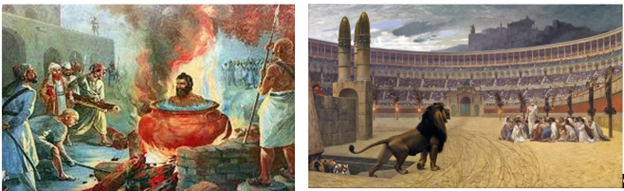
1) “Martyrology” is not Sikh-specific, it’s a long-standing inter-religious category. Centuries before Sikhism, Christianity had already developed formal martyrologies. The Roman Martyrology and later works like Foxe’s *Book of Martyrs* catalogued and commemorated believers who died for their faith. In the first three centuries alone, thousands of Christians were executed across the Roman Empire. Under Nero (64 CE), believers such as Peter and Paul were killed—Peter crucified (possibly upside down), Paul beheaded. Polycarp of Smyrna (c. 155 CE) was burned alive, declaring, ‘Eighty-six years I have served Him, and He has done me no wrong; how can I blaspheme my King?’ Perpetua and Felicitas (203 CE) faced wild beasts rather than renounce Christ. The Decian (249–251 CE) and Diocletian (303–311 CE) persecutions sought the eradication of Christianity empire-wide, producing an enormous number of martyrs commemorated in early liturgy and annual feast days.
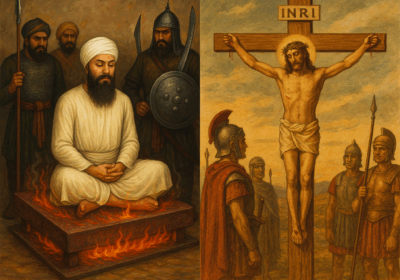
2) Methods of execution under Roman persecution were brutal and varied. Roman authorities used crucifixion, beheading, burning alive, exposure to wild animals in the arena, drowning, scourging to death, and being roasted on grates (as with Lawrence of Rome). Some martyrs were sewn into animal skins and torn apart by dogs, others were coated with pitch and set alight to illuminate imperial gardens. These public spectacles were designed to deter conversion to Christianity and to humiliate the victims. By comparison, Sikh martyrs under Muslim rulers in Mughal India faced their own forms of cruelty—beheading with a sword (as in the case of Guru Tegh Bahadur), sawing alive (Bhai Mati Das), boiling in water or oil (Bhai Dayal Das), flaying alive (Bhai Mani Singh), and being cut limb from limb. Both Roman and Mughal methods were intended not merely to kill but to terrorize communities and reinforce political-religious dominance.
3) The sheer greater numbers of Christian martyrs dwarf Sikh historical figures. During the Great Persecution alone (303–311 CE), thousands—possibly tens of thousands—were executed across the empire. When one includes the entire first three centuries, the number of Christians martyred is immense, spanning from Britain to North Africa to the Middle East. This far exceeds the numerical totals in Sikh history, where martyrdom was largely confined to the Punjab region and specific political-religious conflicts.
4) Christian martyrdom is not merely historical; it is ongoing at a high daily rate. According to contemporary mission and human rights organizations, an estimated 13–15 Christians are killed each day worldwide specifically for their faith—in countries such as Nigeria, North Korea, Pakistan, and parts of the Middle East. This sustained pattern of martyrdom, continuing into the 21st century, has no modern Sikh equivalent. Today, Sikhs generally live without systematic state-sponsored persecution in most of the world, while Christians remain the most persecuted religious group globally.
5) Comparative scale in other traditions shows Sikh martyrdom is not unique. The Armenian genocide (1915–16) saw over 1–1.2 million Armenian Christians slaughtered. Shiʿa Islam centers its identity on the martyrdom of Ḥusayn at Karbala (680 CE), ritually reenacted each year. Jewish history remembers countless martyrs under Antiochus IV (2nd century BCE) and during the Roman destruction of Jerusalem (70 CE).
6) Sikh history includes paradigmatic martyrdoms but follows a universal pattern. Guru Arjan’s execution in 1606 and Guru Tegh Bahadur’s beheading in 1675 are rightly remembered as supreme sacrifices, yet their pattern—leaders choosing death over compromise—is seen in multiple faiths, most notably the early church under Roman rule.
7) Methodological point: Sikh discourse often uses “shaheed” elastically. In Sikh tradition, ‘shaheed’ may refer to battle deaths, assassinations, and judicial executions. Early Christian usage was stricter—martyrs were those who died specifically for refusing to deny Christ, making the category more precise.
8) Institutionalization and ritualization are widespread, not unique. Christians have maintained daily calendars of saints and martyrs for centuries; Shiʿa Muslims observe Ashura; Jews practice *qiddush ha-Shem*; Armenians commemorate April 24. Sikh remembrance practices fit into this broader human pattern.
9) Conclusion. Sikh martyrdom is historically significant and should be respected, but claims to exceptionalism collapse under historical scrutiny. Early Christian martyrdom—with its vast geographic spread, far greater numbers, extreme execution methods, centuries-long intensity, and continuity into the present—demonstrates that martyrology is an ancient, global, and multi-religious phenomenon, not a Sikh monopoly. Jesus’ own death stands apart—not as martyrdom in the ordinary sense, but as the unique, once-for-all sacrificial offering (bali) for the redemption of humanity.




No Comment! Be the first one.