

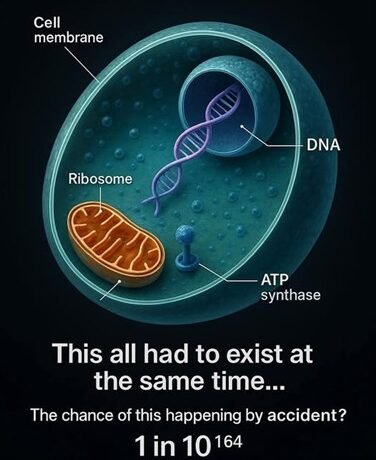

THE STATISTICAL IMPOSSIBILITY OF EVOLUTION:
Why life could never have arisen by blind chance — and why design is the only logical conclusion.
When we examine the sheer mathematical odds behind the origin of life, one fact becomes undeniable: evolution by unguided, random processes is not just unlikely — it is statistically impossible. When we honestly examine the mathematical realities behind the origin of life, we are forced to face an unavoidable conclusion: evolution by random mutation and natural selection simply cannot explain life’s beginning. The odds of even one functional protein forming by accident are so low that it defies comprehension — and life requires hundreds of such proteins, operating in a coordinated system. The time available in Earth’s history is far too short to allow even one such event, let alone the integrated machinery of life. The more science uncovers, the greater the problem becomes. The statistical impossibility of evolution leaves us with only one reasonable explanation: life is the product of intelligent design.
Point 1 — The Numbers Don’t Lie: The Odds Against Random Life
- Probability of functional protein formation (Douglas Axe, 1 in 10⁷⁷)
- 473 essential proteins needed even for minimal life (Craig Venter)
- Entire universe’s available time and space cannot overcome these odds
Point 2 — The Chicken-and-Egg Problem of Molecular Machinery
- DNA needs proteins to replicate — proteins need DNA to be built
- ATP Synthase and ribosomes: irreducibly complex
- No stepwise evolutionary path can account for their coordinated origin
Point 3 — The Logical Conclusion: Design, Not Chance
- Top origin-of-life scientists openly acknowledge the problem (Tour, Meyer)
- Life is based on information, not just chemistry
- Intelligent design is the only explanation that matches the evidence
The deeper science goes into the mystery of life, the clearer it becomes: blind chemistry cannot explain it. Even one functional protein has a chance of 1 in 10⁷⁷ of forming by accident — and a simple living cell requires hundreds of such proteins, DNA, ribosomes, and ATP synthase — all operating in harmony. The entire age of the Earth is far too short for such a complex system to arise by chance. Top origin-of-life researchers today admit that no one has solved this — the more we discover, the more intractable the problem becomes. Creation is not blind faith — it is the logical inference from the overwhelming evidence of design.
Here is additional statistical data supporting the argument that the origin of life by random processes is astronomically improbable:
1️⃣ Probability of a functional protein forming by chance
Even a simple functional protein (say, 150 amino acids long) requires a precise sequence:
Each position has 20 possible amino acids → 20¹⁵⁰ combinations.
That’s ≈ 10¹⁹⁵ possible sequences.
Douglas Axe (Journal of Molecular Biology, 2004):
The probability of a random sequence folding into a stable, functional protein is about 1 in 10⁷⁷ — per protein.
2️⃣ Minimum genes required for life
Craig Venter’s minimal genome project found that 473 essential genes are required for a functioning cell — just to barely stay alive.
Probability of assembling 473 functional proteins simultaneously, by random assembly:
If each protein is 100 amino acids long (conservative), probability ≈ (1 in 10⁷⁷)⁴⁷³ → astronomically impossible.
3️⃣ Formation of DNA/RNA “by accident”
The probability of forming even one functional RNA polymerase (which builds RNA from DNA) is far beyond 1 in 10¹⁰⁰.
And yet:
To copy DNA → need polymerase.
To build polymerase → need information from DNA.
Chicken and egg problem — cannot arise by blind chemical accidents.
4️⃣ ATP Synthase complexity
ATP Synthase is the world’s smallest rotary motor — produces energy (ATP).
Requires over 500 precisely arranged amino acids.
Probability of correct random assembly ≈ 1 in 10¹⁵⁰ for just this one molecular machine.
5️⃣ Origin of life timeframe
Age of Earth ≈ 4.5 billion years
Number of possible molecular “tries” in this time → nowhere close to sufficient to randomly assemble even one self-replicating system.
Harvard chemist James Tour:
“No scientist on Earth can explain how life could arise from non-life through random chemistry. The probability is so low it is functionally zero.”
Probability of life arising by unguided chemical processes:
Less than 1 in 10¹⁶⁴ — probably more like 1 in 10³⁰⁰⁰ or lower.
Creation is not blind faith — it is the most logical inference based on evidence.
“The more we learn, the clearer it becomes:
Life could not arise by random chemistry.
Just ONE functional protein = 1 in 10⁷⁷ chance.
A living cell = 473 proteins + DNA + ATP synthase + cell membrane…
The odds are beyond 1 in 10¹⁶⁴.
Creation is not blind faith — it is the most logical conclusion.”
List of academic references:
Douglas Axe, Journal of Molecular Biology, 2004 — “Estimating the prevalence of protein folds”
→ Probability of functional protein ≈ 1 in 10⁷⁷
Craig Venter et al., Science, 2016 — “Minimal Cell Project“
→ At least 473 genes required for life
James Tour, Rice University Chemist — Multiple lectures (2016–2022)
→ “No scientist can explain life from non-life. The probabilities are functionally zero.”
Stephen C. Meyer, Signature in the Cell (HarperOne, 2009)
→ Comprehensive treatment of the origin of life problem
Books
1. Signature in the Cell by Stephen C. Meyer
The definitive book on the origin of life and the information problem in DNA.
Argues that intelligent design is the best explanation for the digital code in cells.
Accessible for lay readers but scientifically rigorous.
2. The Stairway to Life by Change Laura Tan & Rob Stadler
Analyzes 12 essential steps required for life to begin — and why undirected processes fail.
Clear, technical yet readable — excellent for thinkers and skeptics.
3. The Mystery of Life’s Origin by Thaxton, Bradley & Olsen
The book that launched the intelligent design movement in the 1980s.
Still one of the most powerful critiques of chemical evolution.
Videos / Lectures
1. Stephen Meyer — “The Return of the God Hypothesis”
https://www.youtube.com/watch?v=z_8PPO-cAlA
(Covers intelligent design, statistical probability, origin of information)
2. Douglas Axe — “Undeniable: How Biology Confirms Our Intuition That Life Is Designed”
https://www.youtube.com/watch?v=8Z9T7f7h8HM
(Explains the extreme improbability of functional proteins arising by chance)
3. John Lennox — “Has Science Buried God?”
https://www.youtube.com/watch?v=NJwKkk4qV3k
(Discussion on science, faith, design, and probability arguments)
4. William Dembski — “Intelligent Design and the Death of Materialism”
https://www.youtube.com/watch?v=pE6UQdPqDZo
(Mathematical and probabilistic arguments against chance evolution)
5. Walter Bradley — “The Mystery of Life’s Origin”
https://www.youtube.com/watch?v=qfNEy2uFS1g
(Foundational lecture on thermodynamics, information, and the statistical hurdles of abiogenesis)



Your sentences flow like a soft current, moving ideas and emotion with quiet assurance, producing a reading experience that is immersive, reflective, and gently transformative in its contemplative rhythm.