

TEXTUAL CRITICISM OF THE KARTARPUR GRANTH
By C. H. Loehlin, Dr. J. C. Archer of Yale University & Bhai Jodh Singh
THE SIKH religious community has the unique distinction of having in its possession a manuscript of its original scripture, namely, the Adi G ranth kept at Kartarpur in Jullundur District.[1] This old volume however, seems to have had inappropriate treatment at the hands of the Guru’s enemies, and has sometimes apparently been treated lightly by the Gurus themselves. Perhaps for fear of Muhammedan raids this Granth was kept by Guru Hargobind at his house in Kartarpur. Thence it was stolen by his grandson Dhir Mal, who probably thought that the possession of the Granth would further his aspirations to the Guruship. When the Guru heard of the loss of the Granth it did not seem to concern him greatly; he only said, “Let the Granth Sahib remain with him. When the Sikhs feel devotion they will deprive him of it.”[2] Some thirty years later the followers of Guru Tegh Bahadur recovered the Granth from Dhir Mal; but the Guru ordered it to be turned to him. This order was not obeyed, and when the Guru learned that it was with his retinue he saw to it that it was sent back. Tradition has it that he had it deposited in the river Beas and sent for Dhir Mal to take it back.[3] The Kartarpur Gyani assured us that it was fished out of the water miraculously unharmed; while another tradition says that it was was hidden in the sand of the river. Opinion is generally agreed that it is now in the possession of the Sodhis of Kartarpur; and it seems clear that it has often been in hands that were not particularly friendly.
Let me describe a look I had at this Granth when its possession was under litigation. I quote from my rough notes taken on July 7, 1946:
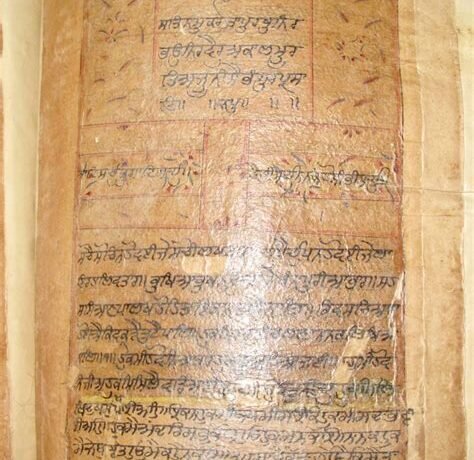
“Kashmiri” paper brownish, about 12″ x 8″ mounted on newer margins which are lighter in colour making the page size about 15″ x 12″. Many erasures, some filled in, but several lines completely blotted out in greenish ink. Some erasures were left white. Mostly written by one hand but size and carefulness varies greatly. Many corrections in the margins. The opening mantra “Ikk Om, Sat Nam” occurs twice. The one in the beginning is said to be Guru Arjan’s writing, but there is no signature; while the one somewhere in the middle is said to be Guru Hargobind’s. Of the former, the Index says it is the Guru’s “Nishan.” Many pages are blank, of the same paper, all numbered. No agreement as to why left blanks according to the giani. Among the blank pages at the very beginning is a page of script which has never been deciphered, even by Kahn Singh of Nabha, according to our giani. (See the remarks by Dr. Archer later.) There are 974 leaves, or 1948 pages. The paper margins were put on by Dhir Mal. Several verses by Kabir in Rag Asa have been obliterated by someone. (End of my notes.)
On November 21, 1946, Dr. J. C. Archer of Yale University and I again saw the Kartarpur Granth. Here is Dr. Archer’s account:
The local guardian of the Granth was ready for us, and we all went, together with the Gyani, tothe Fort and the Shish Mahal, (hall of mirrors) removed our shoes, sat on the rug spread for us, while the Gyani went about opening the safe and exposing the precious volume…it was opened at a stanza from Kabir, which was intended. At last Loehlin and I were invited to move nearer in close proximity to the book. Pages were exhibited at our direction, special features noted and a question-answer conversation carried on. The huge
Book measures about fifteen by twelve inches and is about eight inches thick. It contains 974 leaves, only each leaf bearing a number at the upper left hand corner, even numbered;
therefore 1948 pages including some blank pages (no one seems to know why these blanks are included, nor for what ultimate purpose). The writing is well done and by “one man” so
they said; although the size of the script varies. One page toward the front is ful1 of Gurmukhi letters. As they do not form words, it is assumed these were mere trial writing… A long index of several pages comes first, then the Mul Mantra “inGuru Arjun’s own hand” they say. It is rather crude, although perfectly clear script on a decorated page that is, a decoration across the top, such as has been true of the Koranic Fathah. The effects of erasures are to be seen occasionally…The leaves are all whole save where an insect has done a bit of harm, nothing much. The paper is Kashmiri, a heavy, parchment-like sheet. The tops, bottoms and outer edges are protected by glued on strips. The volume is, of course bound but it opens readily at any part. The covers are a silky golden cloth on board no lettering at all on the outside and there is no record of when, where, by whom it was bound.
The problem of the Book is acute. This is considered to be the Adi Granth, the “original” or only copy in existence of the “original”…But it bears no dates, nor any scribe’s name, nor is its history clear. Its authenticity cannot be proved. It is said that Guru Tegh Bahadur hid it once for fourteen days in the River Beas, to protect it…but there is no sign of water damage. There are copies here and there, in the Golden Temple, for example.[4]
The following note by Dr. Jodh Singh helps explain the blank pages, and the cryptic writing at the beginning; but the longer blanks and erasures still raise questions, as will be noted later.
For the first time I went to Kartarpur on 7th October, 1945 in company of Professor Teja Singh, M.A, of Khalsa college; Amritsar, and Principal Ganga Singh of Shahid Missionary College, Amritsar. The S.G.P.C. had formed a sub-committee to settle the question of Ragmala. We examined the original copy of the Granth Sahib for about six hours and submitted our reports to the Shromani Committee to the effect that Ragmala was in the handwriting of the same scribe who had copied the Bani after assessment by the 5th Guru into that book and was there when the compilation was completed and index prepared.
On 11th November, 1945, I visited the gurdwara again accompanied by Bhai Sahib Singh, lecturer in Sikh Religion, Khalsa college, Amritsar; Master Karam Singh Gangawalia and S. Kehr Singh, Drawing Master, Khalsa College High School, Amritsar, we got a tracing of the writing after the index on pages 21/2 and 22/1 and deciphered it successfully. It was custom amongst Muslims to write medicinal prescriptions on the blank pages which were inserted in the binding to protect the manuscripts of the Quran and some granthi did the same for this volume.
The will on page 28/1, 28 2 had been most probably written by Baba Bhav Singh to impress upon his disciples that his son Guru Niranjan Rai was his rightful successor.
In the first half of August,1944, I again visited Kartarpur. Bhai Mahan Singh, Editor,Khalsa Samachar, accompanied me. I stayed there for five days and made a complete record of the contents of the manuscript, which is with me and which I can show to Dr. Loehlin if he ever comes to Ludhiana:
All the leaves in that volume are numbered but the numbers do not show the pages. When we open the book, the two pages, one the left and the other on the right, constitute one leaf. The number of the leaf is given on the left page. In this note, I shall distinguish the pages as follows:
1/1 means page No. 1 on the left.
1/2 means page No. 2 of the leaf No. 1 on the right.
The date of the completion of the compilation of the books is given on 2/2 as under:
“Index of contents and Rags in the book was begun on Bhadon Vadi 1, Samvat 1661, after completion of the book.”
After that follows the index and gives the leaf on which each Rag begins and first line of each hymn in that Rag. Then a second index under the heading “Index of the indices,” collects all the Rags into 8 clusters and gives the number of the leaf in the index of contents, where these clusters end in the previous index.
The leaves were not written separately. The scribe prepared 122 sets of 8 leaves each and 123rd was of four leaves only. They were numbered and reserved for different Rags into which the hymns would be copied. The Guru had notified to all the Sikhs to bring to him the hymns of the previous four Gurus that they had with them. The 5th Guru critically examined each of the hymns and gave to the scribe those hymns only which were thought genuine.. The scribe went on copying hymns as they were handed over to him in the musical measures to which they belonged. If enough hymns in some musical measure did not come, the remaining leaves reserved for that Rag were left blank. This fact alone proves that the volume at Kartarpur was the original copy, for in no other copy which was made from this manuscript, blank pages are to be found.
When a mistake was made in copying, ‘greenish ink’ or Hartal was used to cover the mistake and then correct rendering was written over it. If the words of lines did not form part of the hymn copied, the greenish ink was used to obliterate them. This has been done in. all the old manuscripts that I have examined.
The volume was not stolen by Dhirmal. When the scuffle began with the Mughal armies in the times of the 6th Guru, the volume was brought from Amritsar to Kartarpur by the Guru himself who had transferred his own residence to that town. When he left Kartarpur for Kiratpur after his 4th battle, the volume remained at Kartarpur. The 6th Guru left for Kiratpur immediately after the battle and asked Bhai Bidhi Chand to escort his family and luggage to that place. Dhirmal, his eldest grandson, who had proved a traitor to the cause in that skirmish, did not hand over the volume to Bhai Bidhi Chand even when specially requested. After the ascension of the 8th Guru, Dhirmal came to Baba Bakala with the volume to establish himself as the Guru, because the 8th Guru had told the congregation that his successor was to be found at Bakala. When his masand Shihan attacked Guru Tegh Bahadur and took away all his property, the Sikhs retaliated and ransacked the house of Dhirmal but the 9th Guru reprimanded them and had the whole property and the volume returned to Dhirmal. It has remained with his descendents up to this day.
From Dr. Jodh Singh’s careful investigation, then the authenticity of the Kartarpur Granth’s claim to be the original manuscript dictated by Guru Arjan is established by the blank pages scattered throughout the Book. The cryptic writing at the beginning turns out to be, probably, the ink formula used, often given in old manuscripts. The authenticity of the disputed Rag Mala (List of Tunes) at the end also has been proved.
Many scholars, however, claim originality for the Bhai Banno edition, the Kari (Bitter) Bir, because it contains passages missing from the Kartarpur manuscripts. Two of these, the hymn of Mira Bai and that of Sur Das are important only as textual problems; but the section in the Ramkali Rag by the 5th Guru has ritual importance as well. In it Guru Arjun describes the puberty rites conducted for Hargobind, when his head was shaved according to the old Hindu rite of chaula, or tonsure. Only the preliminary verse is given in the Kartarpur manuscript, followed by a blank page.
The solution of such questions seems impossible because of the inaccessibility of these manuscripts, especially the Kartarpur one. A basic problem is that of the ownership and custody of the Kartarpur Granth itself. Why was private ownership sanctioned by the ninth Guru himself, and in the hands of one who tried to assassinate him? To exemplify forgiveness, perhaps; but this precedent resulted in the District Court of Jullundur a few years ago giving ownership and possession to the Sodhi family of Kartarpur descending from the traitor Dhirmal!
The effect has been a set-back to scientific investigation into the actual original text of the Kartarpur Granth. For example, a few years ago an attempt was made to photograph every page of the Granth. Special apparatus was secured by a noted Sikh scholar. This attempt to preserve the text in case anything happened to the original would seem most reasonable and helpful, but it caused a tremendous stir among the Nihangs and other fanatical groups. Their reaction was to the effect that “You will photograph the naked body of our Guru over our dead bodies!” So the matter was dropped.
The obvious place to keep the Kartarpur Granth would be in the Treasury of the Golden Temple at Amritsar, or in the department of Historical Manuscripts at Guru Nanak Dev University, Amritsar. It would then be open to qualified investigation. Special photography might even decipher the words and text blotted out. Could a group of distinguished Sikhs visit the Kartarpur Sodhis and request possession of the precious manuscript in the name of the whole Sikh Panth?
A search of the Sikh Review, Calcutta, of the past two years does not seem to have any
reference to the textual problems of the original Granth, but there is an appreciation of the unique value of the Kartarpur Granth. In the August 1975 issue under “Facets of Sikhism” by Bhayee Ardaman Singh, we find the following:
We have our Scripture, the Guru Granth Sahib. Without meaning any disrespect to anyone, the fact is that it is the only Scripture in the World which is written, prepared, and sealed by the Founder who directly received the Word. (p. 31.)
Would this were true, as it may be; but such a forthright statement requires further study and proof to put the issue beyond all doubt.
(reference: SIKH STUDIES Comparative Perspectives on a Changing Tradition, edited by Mark Juergensmeyer and N. Gerald Barrier, 1979, ISBN #0-89581-100-6, pp 113-118)
[1] “The first portion of this paper was originally presented at the Punjab Histor7 Conference, November 12‑14, 1966, in Simla, India.
[2] Macauliffe, The Sikh Religion, IV, 213.
[3] Macauliffe, IV, 337 and footnote.
[4] Cathaline Alford Archer, John Clark Archer, A Chronicle, 1959, privately printed.



It would be truly helpful if you guys could put a feature to download the article with one click.Btw its a gem which is rare to find.God bless