


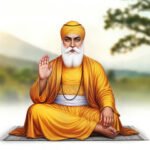
From childhood, Sikhs are taught to revere Baba Nanak as a man of deep insight and devotion. Yet sincere seekers of truth must ask a deeper question: Who truly speaks with the authority of Heaven—one who claims mystical visions, or One who came from Heaven and proved it?
1. Jesus Claimed to Come from Heaven—and Proved It
Jesus of Nazareth declared, “I came down from Heaven” (John 6:38). Unlike any guru, bhagat, pir, prophet or teacher, He claimed divine origin—not merely enlightenment, but pre-existence with God. To validate this claim, He offered the ultimate proof: His bodily resurrection from the dead. No founder of any world religion, including Baba Nanak, ever substantiated his message with such empirically verifiable evidence—evidence inadvertently corroborated even by His enemies, who claimed His disciples stole the body.
2. The New Testament Is Eyewitness Testimony—The Janam Sakhis Are Not
The New Testament rests on historical bedrock. The Gospels were written by or from the direct testimony of eyewitnesses: Matthew and John walked with Jesus; Mark recorded Peter’s memories; and Luke, a trained historian, carefully investigated all eyewitness accounts (Luke 1:1–4). Their writings were composed within living memory of the events, circulated among those who could confirm or deny them. By contrast, the Janam Sakhis are not eyewitness accounts. They are devotional folklore written generations later. The only man who could have been a true eyewitness—Mardana, Nanak’s lifelong companion—wrote nothing. His silence contrasts sharply with the chorus of witnesses who saw Jesus, wrote about Him, and changed history.
3. “Never a Man Spoke Like Him”
Even His enemies were awestruck. When officers were sent to arrest Jesus, they returned confessing, “Never a man spoke like this Man” (John 7:46). His words carried divine authority—piercing hypocrisy, elevating the poor, and exposing the heart’s true condition. No other teacher’s words have reshaped civilizations, abolished slavery, inspired hospitals, or transformed hearts across two millennia.
4. The Highest Moral Standard: The Sermon on the Mount
In His Sermon on the Mount (Matthew 5–7), Jesus articulated the greatest ethical vision ever spoken: love your enemies, forgive those who wrong you, give without show, and pursue purity of heart over ritual display. He redefined righteousness—not as external observance but as inner transformation. Even secular scholars regard this sermon as the pinnacle of moral literature. Baba Nanak urged humility and virtue, but his hymns never reach this luminous clarity. The Sermon on the Mount stands alone as the moral Everest of human thought.
5. His Family Believed After the Resurrection
Jesus’ own brothers once mocked Him (John 7:5). Yet after His crucifixion and resurrection—witnessed by more than 500 people (1 Corinthians 15:6)—these same skeptics became fearless believers. James, His brother, became the first bishop of Jerusalem and died a martyr’s death proclaiming the risen Christ. Such transformation cannot be explained by imagination or myth. The resurrection turned doubt into conviction, fear into faith, and despair into world-changing courage.
By contrast, Baba Nanak’s own sons did not believe his teachings—Sri Chand founded the ascetic Udasi sect, while Lakhmi Das lived a worldly life. Because of this, neither was considered fit to succeed him as the next guru. Moreover, there is no valid historical evidence that Nanak’s parents or his sister Nanaki believed in him or his message.
6. He Changed the World in 42 Months Without Leaving Israel
In barely three and a half years, Jesus changed the moral direction of the human race. Without armies, wealth, or power—and without traveling beyond a few hundred miles of His birthplace—He reshaped civilization itself. His words have been translated into more languages than any other writings; His followers number in the billions; our calendar itself is dated from His coming. Baba Nanak, despite seventy years of life and (alleged) travels from India to Arabia and Tibet, remained a regional figure. Jesus’ influence transcends geography, language, and time—the most decisive life ever lived.
7. Jesus Claimed What No Other Guru Dared to Claim
Baba Nanak called himself a servant and messenger of God. Jesus called Himself the Son of God, equal with the Father. “Before Abraham was, I Am” (John 8:58)—He invoked God’s eternal Name (I am), claiming deity itself. Nanak pointed to the truth; Jesus declared, “I am the Truth.” Nanak sought the light; Jesus said, “I am the Light of the world.” One searched for God—the other was God.
8. Grace Versus Effort
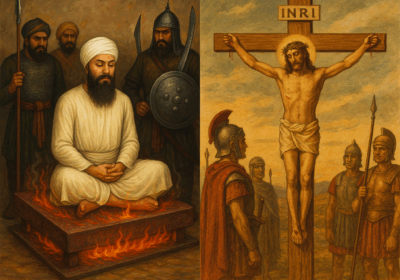
Sikhism teaches liberation (mukti) through remembering God’s Name (Naam Simran), living righteously, and receiving grace earned through devotion. Jesus taught that salvation cannot be earned—it must be received. “By grace you are saved through faith,” wrote the apostle Paul (Ephesians 2:8). The Gospel offers what religion cannot: forgiveness and new life as a free gift through Christ’s sacrifice. Baba Nanak died peacefully; Jesus died purposefully—bearing the world’s sin, then rising in triumph to offer eternal life.
9. Eyewitness Power, Not Mythic Silence
The apostles saw, heard, and touched the risen Jesus. They faced persecution, exile, and death rather than deny what they had witnessed. Their accounts formed the New Testament—a record unmatched in historical verification. The Janam Sakhis, by contrast, emerged generations after Nanak’s death, blending devotion with myth. Mardana’s silence remains an unanswerable void next to the fearless voices of those who testified, “We have seen the Lord.”
10. Truth Demands Evidence, Not Tradition
Sikhs rightly value Sat—truth. But truth cannot rest on emotion or heritage; it must rest on evidence. The resurrection of Jesus is a public, historical event, attested by eyewitnesses and confirmed by an empty tomb. The throne-room stories about Nanak have no historical corroboration. The difference between Jesus and Nanak is the difference between revelation verified in history and legend preserved in late hagiographic accounts.
11. Jesus Is the Fulfillment of the Satguru Ideal
Sikh Gurus longed for the Satguru—the True and Eternal Teacher who unites man with God. That ideal finds its complete fulfillment in Jesus Christ. He is not one guru among many; He is the Living Satguru who conquered death. “In Him was life, and that life was the light of men.” The eternal Satguru the Sikh heart longs for has already come—and He still lives.
12. Why It Matters for Sikhs
This is not a clash of cultures and Sikh identity—it is a question of truth. The resurrection of Jesus is not mythology; it is documented history. The Janam Sakhis are pious folklore. If Baba Nanak genuinely sought Sat, then his true followers must do the same. Jesus is that Sat made visible—God’s truth in human form, the Satguru in His final and eternal sense.
13. A Call to Every Sikh Seeker
Baba Nanak urged all to seek truth wherever it may be found. Jesus gives the same invitation. Examine His life, His words, and His resurrection. To listen to Jesus is not to reject Nanak’s devotion to the One God—it is to embrace its fulfillment, for in Jesus the lifelong search of the Sikh gurus finds its end and its answer.
As the apostle Peter boldly proclaimed in the Temple before the religious leaders and the gathered crowds, “There is no other name under heaven given among men whereby you must be saved” (Acts 4:12).
The bridge from search to fulfillment is not religion—it is a Person – the Satguru Jesus Christ.
14. The Invitation
Jesus still speaks to every seeker: “I am the way, the truth, and the life; no one comes to the Father except through Me.” (John 14:6) To listen to Jesus is not betrayal—it is discovery. It is to step from shadows into Light, from effort into grace, from religion into relationship with the Living God.
By Jasvir Singh Basi
Founder of Truth Sikhers – www.truthsikhers.com



Great work my brother. come to annual Bible conference in abbotsford