

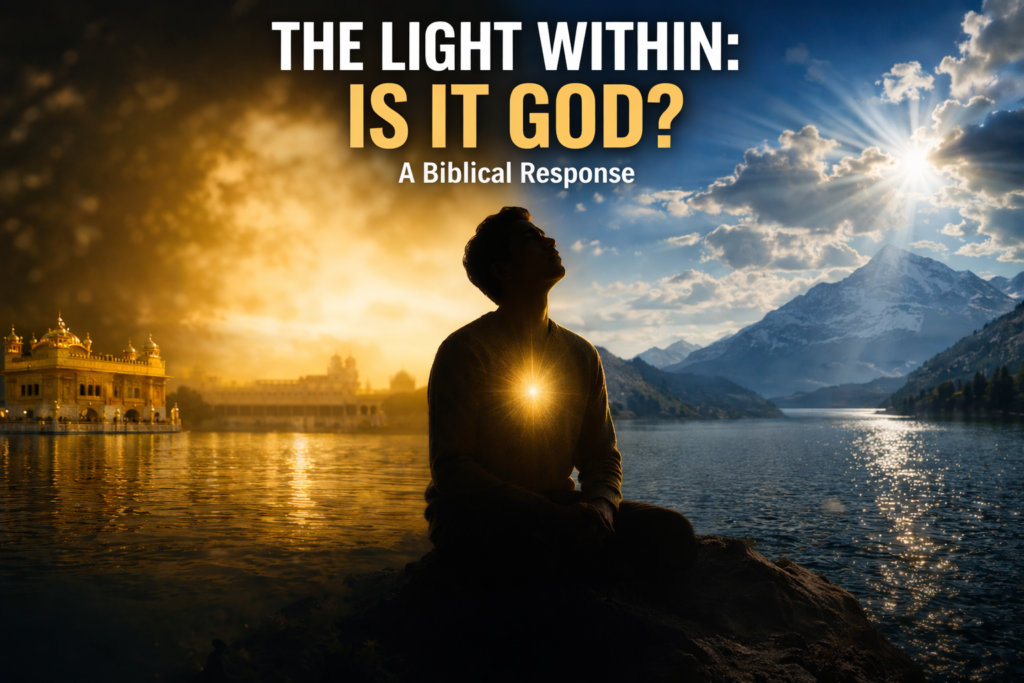
The phrase “Sabh Meh Jot” in the Adi Granth (AG) expresses a deeply meaningful conviction in Sikh thought—that there is a Divine light present in all people. This article seeks to take that idea seriously and examine it in the light of the Bible.
The Adi Granth states:
ਗਉੜੀ ਸੁਖਮਨੀ ਮਃ ੫ ॥ ਸਭ ਮਹਿ ਜੋਤਿ ਜੋਤਿ ਹੈ ਸੋਇ ॥ ਤਿਸ ਕੈ ਚਾਨਣਿ ਸਭ ਮਹਿ ਚਾਨਣੁ ਹੋਇ.
“The Divine Light is in all; that Light is the same. By His Light, all are illumined.” (AG p.294, M5)
This is a powerful and attractive idea. It resonates with human experience—we all sense an inner awareness, a moral voice, a kind of “light” within. The question is not whether such a light exists, but what that light actually is.
The Holy Bible says:
“The true light, which gives light to everyone, was coming into the world.”
(John 1:9).
This verse introduces the “true Light” as something distinct from the light experienced within us.
There is a shared truth recognized by both the AG and the Bible: there is a kind of light present in every human being. Every person has an inner awareness of God. No one is completely without light. All people possess a sense of right and wrong, an internal moral awareness that cannot easily be denied.
The Bible explains this reality clearly:
“…their conscience also bearing witness, and their thoughts alternately accusing or else defending them.” (Romans 2:15)
In Romans 2:15, it is identified as conscience. It bears witness within us, and our thoughts either accuse us or defend us. This means that every human being has an internal moral compass. However, this light, though real, is limited. It does not make us perfect, nor does it give us complete knowledge of God.
But the Bible also speaks of another kind of light—an external light that comes through creation itself. In Romans 1:20, we are told that God’s invisible attributes are clearly seen through what has been made.
“For since the creation of the world His invisible attributes are clearly seen, being understood by the things that are made…” (Romans 1:20a).
The created world reveals God’s power, wisdom, and divine nature. This is often called general revelation. It is not inside us, but outside us—visible, observable, and universal.
This means that every human being is surrounded by light as well as having light within. The conscience testifies internally, while creation testifies externally. Together, they leave humanity without excuse.
“… so that they are without excuse.” (Romans 1:20b)
We know there is a moral law within us, and we see evidence of a Creator around us. The verse quoted above from the Adi Granth recognizes the inner dimension of this reality. However, other passages show that it draws a fundamentally different conclusion. The Adi Granth states that the Divine Light is in all and assumes that this inner light is God Himself. In doing so, it moves from observing a real human experience—the presence of inner awareness of God—to identifying that awareness as the Divine.
This conclusion does not arise in isolation. It flows out of the broader worldview reflected in the Adi Granth, where ultimate reality is often described in terms that collapse the distinction between God and creation. In many passages, God is not only said to be present in all things, but to be all that exists. Creation is portrayed as an emanation from the Divine and ultimately identical with it. This is what is commonly called a pantheistic or monistic framework—where all reality is understood as one, and the difference between Creator and creation is blurred or dissolved.
Within that framework, it is natural to interpret the inner awareness of conscience, as God Himself within the individual. If everything is, in essence, one divine reality, then the “light” experienced within human beings is not merely a witness to God—it is taken to be God.
But this is precisely where the Bible draws a clear line. The inner awareness we experience is real, but it is not God. It is a created faculty that points beyond itself. Likewise, the external world reveals God, but is not God. The Bible consistently maintains a distinction between the Creator and His creation, even while affirming that God is active and present.
This distinction is not a minor detail—it goes to the heart of truth and deception. From the very beginning, Satan told Eve, “you will be like God” (Genesis 3:5). The temptation was not merely to disobey, but to blur the line between the human and the Divine—to suggest that what is created can become or share in the very nature of God.
This is not a peripheral issue in the AG. The claim that the Divine is “in all” is not incidental but pervasive—repeated well over 500 times through expressions such as ghat ghat (“in every heart”), sabh meh (“in all”), and related language. In context, these are not isolated devotional statements but reflect a consistent pattern: the inner life of man is identified with the Divine, implying an ontological identity between man and God. As a result, what the Bible treats as a witness to God—the light of conscience—is instead taken to be God Himself. In simple terms, the line between Creator and creation is not merely softened or blurred; it is, in effect, erased again and again.
That is why this issue cannot be treated as minor. It echoes the core deception recorded in the Holy Bible, when Satan said to Eve, “you will be like God” (Book of Genesis 3:5), erasing the distinction between Creator and creature. The Bible, by contrast, insists that this distinction is essential to truth. The light within us points to God—but it is not God Himself—and to confuse the two is to mistake the witness for the One to whom it points.
Put simply, the AG identifies the light within us as God because its worldview tends to merge God and creation into one reality. The Bible, however, distinguishes between the light within us (conscience), the light around us (creation), and the true Light Himself—Jesus Christ.
The Bible, however, distinguishes between the light within us (conscience), the light around us (creation), and the true Light—Jesus Christ, the source of all light—who is “the true light, which gives light to everyone, and came into the world” (Gospel of John 1:9). He gives light to everyone, but He is not the same as the inner voice of conscience or the external testimony of creation. Both the inner witness of conscience and the external testimony of creation point toward Him, but neither is identical with Him.
The key issue, then, is not whether we have light, but what that light reveals about us. Conscience shows that we fall short—that we sin and need salvation. Creation shows that there is a Creator to whom we are accountable. Together, they testify that we are morally responsible and spiritually needy—but neither can save us.
Jesus Christ is the true Light. He reveals God, exposes sin, and offers forgiveness and new life—what conscience and good works cannot accomplish. The inner light you experience is real, but it is not God; it points beyond itself to Him. Your conscience affirms what is right and convicts you when you fall short. It is God-given, but it cannot save you—it is meant to lead you to the One who can.
CONCLUSION
There is light within us and light in creation. The Bible clarifies that the light within is conscience and the light around us is creation. Both point to God, but neither is God. The true Light is Jesus Christ. The issue is not whether you have light—it is whether you will come to Him.


No Comment! Be the first one.