

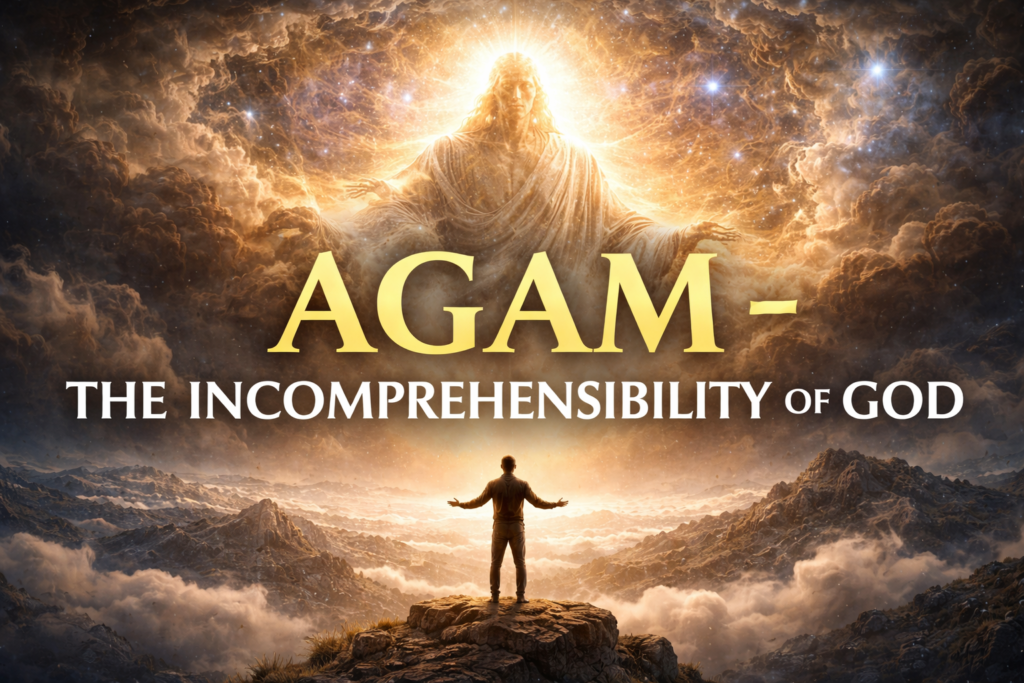
The “Agam” Problem in the AG
What Does “Agam” Really Mean?
The 268 occurrences of “agam” do not clarify the doctrine—they expose a theological contradiction.
By Jasvir Singh Basi
Founder of TruthSikhers – www.truthsikhers.com
ਨਿਹਚਲੁ ਏਕੁ ਨਰਾਇਣੋ ਹਰਿ ਅਗਮ ਅਗਾਧਾ ॥
Nihchal ék naaraa▫iṇo har agam agaaḋʰaa.
The One and only Lord is eternal, imperishable, inaccessible and incomprehensible.
I. NOT ONE VERSE – A SYSTEM-WIDE PATTERN
A. Scope of the claim
1. A search of the AG reveals approximately 268 occurrences of the term ‘Agam’ (ਅਗਮ).
2. This is not a marginal or occasional descriptor. It is a repeated doctrinal claim about the nature of Ultimate Reality.
a. In other words, the term is functioning as a doctrinal descriptor rather than as an incidental poetic flourish.
3. The term is consistently applied directly to God in phrases such as ‘Har Agam’, ‘Prabh Agam’, and ‘Agam Agochar’.
4. Therefore, the concept of divine incomprehensibility is not incidental but foundational.
II. SEMANTIC AND PHILOSOPHICAL IMPLICATION
A. What the term implies
1. The word ‘Agam’ carries strong epistemological weight. It does not merely suggest difficulty of understanding.
2. Rather, it denotes that God is beyond cognitive access—beyond reach, beyond comprehension, and beyond conceptual grasp.
a. This is stronger than merely saying that God is difficult to understand.
b. It presents God as lying beyond ordinary cognitive access.
3. In philosophical terms, this implies epistemic inaccessibility: the impossibility of forming true knowledge about the object in question.
i. That is, epistemic inaccessibility means the object cannot be known in a meaningful, truth-bearing way.
4. If taken at face value, this eliminates the possibility of meaningful theological statements about God.
III. THE SELF-REFERENTIAL CONTRADICTION
A. The two claims being made
1. The AG repeatedly asserts that God is incomprehensible.
2. At the same time, it makes extensive claims about God’s nature, attributes, actions, and relationship to the world.
B. The contradiction itself
1. This creates a classic self-referential contradiction.
2. If God cannot be known, then no statements about Him can be justified.
a. If God cannot be known, then theological predication about God loses justification.
3. Yet the AG makes precisely such statements throughout.
4. Thus, the text undermines its own assertions.
IV. INTERNAL VERSE-LEVEL TENSION
A. The tension within individual lines
1. The contradiction is not merely theoretical but appears within individual verses.
2. God is described as ‘Agam Agochar’—inaccessible and incomprehensible.
3. In the same breath, He is said to be known through the Guru or realized through the Shabad.
4. This produces a direct logical conflict.
B. Why this matters logically
1. An entity cannot simultaneously be unknowable and knowable in the same respect.
a. The same subject cannot be both knowable and unknowable in the same respect at the same time.
V. FAILED HERMENEUTICAL RESCUE
A. The standard escape attempt
1. A common attempt to resolve this tension is to redefine ‘Agam’ as ‘not fully knowable’.
2. However, this move imposes a meaning onto the text rather than deriving it from it.
B. Why the move fails
1. This is an instance of hermeneutical subjectivism.
a. The interpreter is softening the force of the wording in order to preserve coherence.
2. The language of the text remains absolute and unqualified.
VI. CATEGORY ERROR
A. The conceptual mistake
1. The AG commits a category error by speaking about an entity it declares to be beyond all description.
2. To claim that God cannot be described while simultaneously describing Him is logically incoherent.
3. It collapses the distinction between meaningful and meaningless statements.
a. Once meaningful predication is denied, continued predication becomes internally unstable.
VII. REPETITION AND SYSTEMIC FAILURE
A. Why repetition intensifies the problem
1. The problem is compounded by repetition.
2. A single contradiction might be attributed to poetic tension.
3. However, 268 occurrences demonstrate that the issue is systemic.
4. Each repetition reinforces the same contradiction, leading to cumulative self-defeat.
a. Repetition does not solve contradiction; it multiplies it.
VIII. EPISTEMOLOGICAL CONSEQUENCES
A. What follows if the claim is taken seriously
1. If the doctrine of incomprehensibility is taken seriously, it leads to epistemological collapse.
2. No reliable knowledge of God becomes possible.
3. All theological claims become equally unjustified.
4. This undermines the entire religious framework.
a. A theology that cannot justify its own claims cannot function as a stable revelation.
IX. CONCLUSION
A. The central result
1. The repeated use of ‘Agam’ reveals a fundamental contradiction.
2. The AG denies the possibility of knowing God while simultaneously making claims about Him.
B. Implication for divine revelation
1. A genuine divine revelation must be coherent and communicate meaningful knowledge of God.
2. A text that collapses into contradiction cannot meet this standard.
3. Therefore, the AG cannot be sustained as a clear and reliable divine revelation.
4. Instead, it reflects human attempts to articulate the divine that result in conceptual incoherence.



No Comment! Be the first one.